Best Bathroom Exhaust Fans
Best Bathroom Exhaust Fans, ranked from aggregated owner ratings and reviews, not first-hand testing. Real pros, cons, and who each pick is best for.

Our Top 3 Picks
Quick Comparison
| Product | Best for | Buy | |
|---|---|---|---|
| WhisperCeiling FV-08VKS2 | Best Overall | See Amazon | View |
| 678 | Best Value | See Amazon | View |
| BreezSignature SIG80L | Best Fan/Light Combo | See Amazon | View |
| WhisperGreen Select FV-1115VK2 | Best Smart Pick | See Amazon | View |
| QTXE110 | Best for Large Bathrooms | See Amazon | View |
| 7141-80-BT | Best Bluetooth Option | See Amazon | View |
What to Look For When Choosing a Bathroom Exhaust Fan
Start With CFM, Sized to Your Room
Match capacity to your actual bathroom, not a generic number. Use roughly 1 CFM per square foot of floor area with a 50 CFM floor for small powder rooms, then add for fixtures: about 50 CFM for a shower or standard tub, and 100 CFM for an enclosed toilet room. A typical 5-by-8-foot bathroom with a tub-shower lands around 80-90 CFM once you add the fixture allowance — which is why 80 to 110 CFM is the sweet spot for most of the products below. Long or elbow-heavy duct runs reduce real-world airflow versus the rated CFM, so size up if your run to the exterior isn't short and straight.
Check the Sone Rating, Not Just the CFM
A fan only removes moisture while it's running, and a loud fan gets switched off early. Look for 1.5 sones or quieter for a fan you'll actually want to leave on for the full cycle; anything under 1.0 sone is genuinely unobtrusive. Builder-grade fans in the 3-4 sone range are noticeably louder and worth avoiding if noise has been a complaint with your current fan.
Confirm ENERGY STAR Certification
ENERGY STAR certification requires a minimum CFM-per-watt efficiency and a maximum sone rating, so it's a fast way to screen out inefficient, noisy units without comparing every spec sheet line by line. Certified fans typically use 60-70% less energy than non-certified builder-grade models for comparable airflow.
Decide Whether You Want a Humidity Sensor or Smart Controls
A built-in humidity sensor turns the fan on automatically once relative humidity rises and shuts it off once the room dries out, which solves the most common real failure mode — a perfectly good fan that nobody remembers to run long enough. Motion-sensing and multi-speed models add further automation. These features add cost, so they're worth it mainly for households that already know they forget to run the fan manually.
Match the Duct Connector Size
Most 80-110 CFM residential fans use a standard 4-inch round duct connector; higher-CFM units sometimes step up to 6-inch. Check this before buying if you're keeping existing ductwork, since a mismatched connector needs an adapter and can restrict airflow if downsized.
Housing Type: Retrofit vs. New Construction
If you're replacing an existing fan in the same location, look for a housing designed for retrofit installation through the existing ceiling opening. If you're adding a fan where none exists, or roughing in during a remodel, a new-construction housing mounted to the joists before drywall goes up gives a cleaner result and more flexibility for duct routing.
Fan-Only vs. Fan/Light or Fan/Heater Combo
A fan-only unit is the simplest and usually quietest option per CFM dollar. Fan/light combos consolidate two fixtures into one ceiling opening, which is convenient in a small bathroom, though replacing the bulb or LED module later means accessing the same housing. Fan/heater combos add real value in cold climates but draw significantly more power and need a dedicated circuit in many cases — confirm your electrical panel has the capacity before choosing one.
Who Should Skip a Standard Fan
A single standard fan generally isn't the right tool for a very large primary bathroom (over roughly 100 square feet), a bathroom with a separate enclosed toilet room plus a large soaking tub, or a spa-style bathroom with a steam shower — these situations often call for a higher-CFM unit, two fans, or a dedicated ventilation plan rather than picking the biggest single fan on a list. If you're in that situation, size using the full room-plus-fixture calculation above rather than assuming one fan from a general buying guide will cover it, and consider consulting an HVAC contractor for a whole-bathroom ventilation plan.
Installation Reminder
Whichever fan you choose, remember it's a hardwired fixture: turn off power at the breaker and confirm it's dead with a voltage tester before any wiring work, and hire a licensed electrician for anything beyond a straightforward like-for-like swap — especially if a new fan-rated housing, new duct run, or new switch wiring is involved.
Full Ranking, Reviewed

Best for Homeowners who want a proven, whisper-quiet fan for a standard bathroom
- 80 CFM output rated at 0.3 sones, among the quietest in its class
- ENERGY STAR certified for efficient continuous or spot ventilation
- 4-inch duct connector fits most existing residential ductwork
- Compact, low-profile housing suited to retrofit installations
- Extremely quiet even on continuous operation
- Long track record of reliability in the WhisperCeiling line
- Straightforward retrofit into most existing housings
- Fan-only, no integrated light or heater option in this model
- 80 CFM may be undersized for larger bathrooms with a separate toilet room
Verdict: A dependable, near-silent workhorse for a standard bathroom, and the fan most often recommended as a default upgrade from a noisy builder-grade unit.

Best for Budget-conscious replacements in small to mid-size bathrooms
- 50 CFM output suited to smaller bathrooms and powder rooms
- Simple, widely available retrofit housing
- Polymeric grille resists moisture and corrosion
- One of the best-selling fans in the category for decades
- Low upfront cost
- Easy like-for-like replacement for older Broan-NuTone models
- Widely stocked, so parts and matching grilles are easy to find
- 4.0 sone rating is noticeably louder than premium quiet models
- 50 CFM is only enough for small bathrooms, not larger or fixture-heavy rooms
Verdict: A no-frills, inexpensive option that gets the job done in a small bathroom, but budget for a quieter unit if noise has been the reason for replacing your old fan.
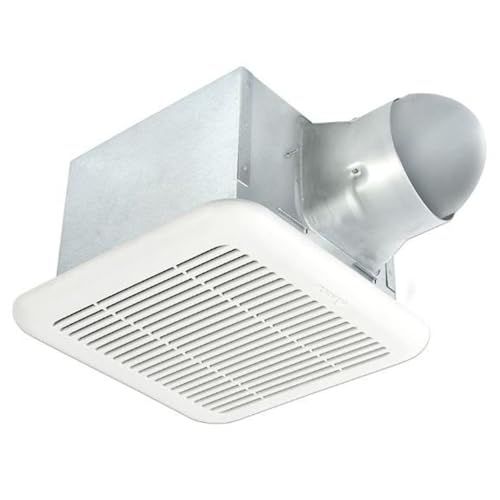
Best for Bathrooms that need a fan and a light fixture from a single ceiling opening
- 80 CFM fan combined with an integrated LED light
- ENERGY STAR certified for the fan/light combo
- Slim housing designed for tighter ceiling joist bays
- Quiet operation rated under 1.0 sone
- Consolidates two fixtures into one housing and ceiling cutout
- Quiet for a combo unit
- Clean, low-profile trim
- Costs more than a fan-only unit of similar CFM
- Replacing the LED module later means accessing the full housing
Verdict: A tidy solution for bathrooms without room for a separate light fixture, without giving up the quiet operation you'd expect from a fan-only model.

Best for Households that want automated, humidity-driven ventilation
- Multi-speed airflow selectable from 80 to 110 to 130 CFM in one unit
- Built-in humidity sensor with adjustable trigger threshold
- DC motor for quiet, energy-efficient operation
- ENERGY STAR certified
- One housing covers a range of room sizes via selectable CFM
- Humidity sensor automates on/off so the fan actually gets used long enough
- Very quiet DC motor operation
- Higher price than a basic fixed-speed fan
- Initial speed and sensor setup takes a bit more time than a plug-and-play unit
Verdict: The pick for anyone who wants ventilation to happen automatically rather than relying on someone remembering to flip a switch.

Best for Larger primary bathrooms or rooms with a separate enclosed toilet area
- 110 CFM output for larger floor areas or fixture-heavy bathrooms
- Ultra Silent series rated at 0.3 sones
- ENERGY STAR certified
- 4-inch duct connector
- Higher CFM covers larger bathrooms without stacking multiple fans
- Remarkably quiet for its output level
- Trusted, well-established product line
- Costs more than the base 678 or WhisperCeiling models
- Oversized for a small powder room, where a lower-CFM fan is a better fit
Verdict: The right call for a bigger bathroom or one with a tub, shower, and enclosed toilet room all sharing a single ventilation point.
Best for Anyone who wants Bluetooth audio built into their ventilation fan
- 80 CFM fan with a built-in Bluetooth speaker
- ENERGY STAR certified
- LED light included in the housing
- Simple pairing with any Bluetooth-enabled phone or tablet
- Genuinely useful added feature for a bathroom without a separate speaker
- Combines fan, light, and audio in one ceiling fixture
- Competitive CFM and efficiency for the category
- More features to potentially need troubleshooting than a basic fan
- Not the quietest option on this list at full speed
Verdict: A fun, practical upgrade for anyone who wants music or podcasts in the bathroom without adding a separate speaker, without sacrificing core ventilation performance.
Frequently Asked Questions
What CFM bathroom fan do I need?
Use roughly 1 CFM per square foot of bathroom floor area with a 50 CFM minimum, then add about 50 CFM for a shower or tub and 100 CFM for an enclosed toilet room. Most standard bathrooms with a tub-shower land in the 80-110 CFM range, which is why that's the most common capacity among top-rated fans.
Is a quieter fan worth paying more for?
Usually yes. A fan only clears moisture while it runs, and a loud fan (3-4 sones or louder) tends to get switched off early or avoided altogether. Fans rated 1.5 sones or quieter cost more up front but get used for the full cycle, which is what actually prevents mold and lingering humidity.
Do I need a humidity-sensing fan?
Not everyone does, but it helps in households where the fan often gets left off or shut off too soon. A humidity sensor automatically starts the fan when moisture rises and stops it once the room dries out, removing the need to remember a manual switch.
Can I install a bathroom exhaust fan myself?
A straightforward swap onto existing housing, wiring, and ductwork is manageable for a confident DIYer who turns off power at the breaker and confirms it's dead before starting. If you need a new fan-rated housing, a new duct run, or new switch wiring, hire a licensed electrician.