Best Tower Fans
Best Tower Fans, ranked from aggregated owner ratings and reviews, not first-hand testing. Real pros, cons, and who each pick is best for.

Our Top 3 Picks
Quick Comparison
How to Choose a Tower Fan
Start with room size, then check CFM
Airflow (CFM) matters more than wattage or blade count. Small bedrooms and home offices do fine
with a compact tower fan in the 200-300 CFM range; open-plan living rooms or larger bedrooms
benefit from 400+ CFM, or from running two fans to cross-ventilate. If a listing doesn't state
CFM, check the full spec sheet or manual before assuming a fan will handle a bigger space — box
copy tends to lean on vague phrases like "powerful airflow" instead of a number.
Match the noise level to the room
If the fan is going in a bedroom, prioritize a published low-speed dB rating and a dedicated
sleep/night mode over a slightly higher top-speed CFM figure. A fan that's whisper-quiet on low
but only used at night is more valuable than one that's louder but only marginally more
powerful on high. For living rooms and offices where background noise is less critical, medium
and high dB ratings in the mid-40s to low-50s are usually unnoticeable once you're doing
something else.
Decide how much oscillation coverage you actually need
Wide oscillation (90 degrees or more) suits rooms where people sit spread out — living rooms,
open offices, shared bedrooms. A narrower, more direct sweep (or oscillation off entirely) is
often better in a single bedroom where you want steady airflow aimed at the bed rather than air
drifting away every few seconds.
Footprint and height
Measure the spot before you buy. Most tower fans have a base between 8 and 12 inches across and
stand 30-42 inches tall — enough to clear a nightstand or low dresser but check clearance under
shelves, TVs mounted low, or sloped ceilings in an attic bedroom. A narrow footprint is the whole
point of a tower fan, so don't undercut that advantage by buying one too tall or too wide for the
corner you have in mind.
Smart control: nice-to-have vs. need-to-have
A remote is now close to standard, and a built-in timer is genuinely useful for both energy use
and safety (auto-off if you fall asleep or leave the room). Wi-Fi and voice control add real
convenience if you already run Alexa or Google Assistant routines, but they're not essential —
don't pay a large premium for "smart" features you won't use through an app you'll only open
once. If app control matters, check whether the fan uses a mainstream smart-home protocol rather
than a niche proprietary app with a short update history.
Filtration is a separate purchase
No tower fan replaces an air purifier. A mesh pre-filter that catches dust and pet hair is a
nice touch for keeping the internals clean, but if allergy relief or smoke/pollen filtration is
the goal, budget for a HEPA air purifier sized to the room and run it alongside the fan.
Who should skip a tower fan
If you're cooling a large, open room and airflow-per-dollar is the top priority, a basic pedestal
or box fan may move more air for less money, since a lot of the tower fan's price premium pays
for the slim cabinet and control electronics rather than raw output. Anyone who wants a fan they
can fully disassemble and hand-wash (blades, grille, motor housing) may also prefer an older-style
pedestal fan — tower fan internals are more enclosed and generally only vacuum-cleanable through
the intake vents.
A word on maintenance and safety
Unplug the fan before any cleaning and never insert anything into the intake or outlet grilles
while it's plugged in. Tower fans are low-voltage plug-in appliances, not hardwired fixtures, so
there's no breaker or wiring work involved in normal use — but if you're integrating one into a
smart outlet, switched receptacle, or any new wiring, turn off power at the breaker first and
have a licensed electrician handle anything beyond plugging into an existing outlet.
Full Ranking, Reviewed

Best for Bedrooms and living rooms that want strong airflow with a genuinely quiet sleep mode
- Multiple speed settings with a dedicated low-noise sleep mode
- Wide oscillation coverage for whole-room circulation
- App and voice control (Alexa/Google Assistant compatible)
- Built-in timer with LED display
- Noticeably quieter than most tower fans at low/medium speed
- App scheduling is genuinely useful, not just a gimmick
- Highest speed setting is considerably louder than low/medium
Verdict: The best balance of airflow, quiet operation, and smart features for most homes.
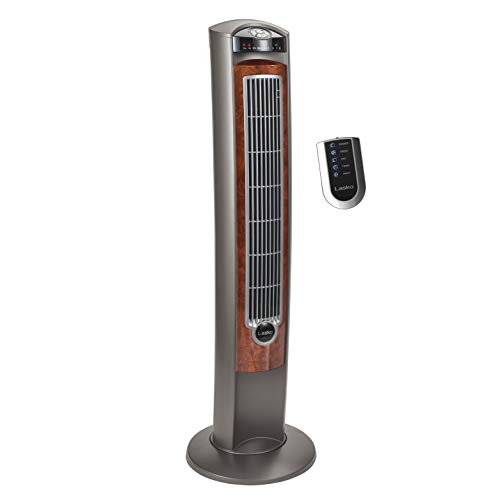
Best for Budget-conscious buyers who want reliable oscillating airflow without extra features
- Three quiet speeds
- Widespread oscillation
- Built-in timer
- Simple electronic controls with remote
- Among the most affordable oscillating tower fans from a major brand
- Lightweight and easy to move room to room
- No app or voice control
- Plastic housing feels less premium than pricier models
Verdict: A no-frills tower fan that covers the basics well for a fraction of the cost of smart models.

Best for Buyers who want the quietest, most refined bladeless-style tower fan and don't mind the price
- Bladeless air-multiplier design with no visible blades to clean around
- Precise airflow control via remote
- Tilting head for adjustable airflow angle
- Compact footprint with a minimalist design
- No fast-spinning blades exposed, which makes it safer around kids and pets
- Smooth, steady airflow with a refined look
- Significantly more expensive than comparable-output conventional tower fans
Verdict: A premium pick for anyone prioritizing design and blade-free safety over value.

Best for Light sleepers who want multiple distinct quiet-setting options rather than one generic sleep mode
- Multiple QuietSet speed settings, from whisper-quiet to full power
- Oscillation on/off control
- Remote control with LED display
- Slim vertical profile for tight bedroom corners
- More granular quiet-speed options than most competitors
- Slim profile fits easily beside a nightstand
- No smart/app connectivity
Verdict: A strong dedicated bedroom fan for anyone who wants fine control over noise level.

Best for Shoppers who want app control plus a mesh pre-filter to keep dust out of the internals
- Wi-Fi app control with schedule and routine support
- Voice assistant compatibility
- Washable mesh pre-filter over the intake
- Multiple speeds with sleep mode
- Pre-filter helps keep the motor and blades cleaner over time
- App scheduling works well for pairing with a smart thermostat
- Initial app setup can be fiddly on some home Wi-Fi networks
Verdict: A solid smart-home-friendly option, especially for households that already lean into automation.
Frequently Asked Questions
What CFM do I need for a bedroom vs. a living room?
A small to medium bedroom is usually comfortable with 200-300 CFM. A larger bedroom or an open living room benefits from 400 CFM or more, or from running two fans to move air across the whole space.
Are tower fans quiet enough for sleeping?
Many are, especially on a dedicated sleep or night mode, which typically runs under 40 dB. Check the manufacturer's low-speed dB rating specifically rather than the overall noise range, since top-speed noise is usually much higher.
Do tower fans need much maintenance?
Mostly just periodic dusting of the intake and outlet grilles with a vacuum brush attachment or damp cloth. Models with a mesh pre-filter should have that filter rinsed or wiped every few weeks during heavy use season.
Can a tower fan replace an air purifier?
No. A tower fan circulates air but doesn't filter fine particles unless paired with a dedicated HEPA air purifier. Some tower fans have a basic mesh pre-filter, but that's for protecting the motor from dust, not for cleaning the air you breathe.
Is a Wi-Fi/smart tower fan worth the extra cost?
It's worth it if you already use Alexa or Google Assistant routines and want the fan to respond to schedules or a smart thermostat. If you'd just use the physical remote day to day, a non-smart model with a timer covers most needs for less money.