Best Floor Lamps For Living Rooms
Best Floor Lamps For Living Rooms, ranked from aggregated owner ratings and reviews, not first-hand testing. Real pros, cons, and who each pick is best for.

Our Top 3 Picks
Quick Comparison
How to Choose a Floor Lamp for a Living Room
Start With the Job the Lamp Needs to Do
Before comparing specific models, decide what the lamp is actually solving for. A floor lamp in a living room is usually filling one of three roles: ambient fill light for a corner that the ceiling fixture doesn't reach, task light for a reading chair, or directional light thrown over a sofa from an arc lamp instead of a side table. Buying for the wrong role is the most common regret - a slim torchiere looks great in a corner but won't give a reading chair enough direct light, while an arc lamp's dramatic sweep can feel oversized in a small room.
Height and Proportion
Living room floor lamps typically run 58 to 65 inches tall. That range keeps the shade near or slightly above seated eye level next to a standard-height sofa, which cuts down on glare while still throwing light where people are actually sitting. In a room with 9-10 foot ceilings or oversized furniture, sizing up toward the taller end (or even 68-72 inches for a tree-style lamp) keeps the proportions from looking stranded. Measure the intended spot before buying - lamps almost always look larger in a room than they do in a product photo.
Brightness and Color Temperature
Check lumens, not watts, on the packaging or spec sheet. For ambient corner lighting, 800-1,100 lumens is a comfortable range; a floor lamp doubling as reading light benefits from 1,000+ lumens aimed more directly downward through an adjustable shade or head. For color temperature, warm white in the 2700-3000K range is the standard choice for living rooms - it reads as relaxed rather than clinical. A dimmable lamp, or one paired with a dimmable smart bulb, adds flexibility for movie nights versus daytime reading without needing two separate fixtures.
Shade Style and Light Direction
A torchiere lamp points its light upward and bounces it off the ceiling, which softens the light but depends on having a light-colored ceiling to reflect off of - it works less well under exposed beams or dark paint. A downbridge or adjustable-head floor lamp sends light down and out, which is better for reading but can feel harsher without a diffusing shade. Arc lamps combine a heavy weighted base with a long curved arm, letting the shade hang directly over a sofa or chair; they need floor clearance to swing into position and a stable, wide-footed base since the arm creates leverage that can tip a lightly-weighted lamp.
Build Quality and Stability
A floor lamp gets bumped and stepped near constantly, so base weight and footprint matter more than they might seem to from a photo. Metal bases with a wide tripod or weighted circular foot resist tipping far better than lightweight plastic ones, especially with pets or young kids in the house. Check the cord length against the distance to the nearest outlet - a lamp that needs an extension cord to reach is both a safety compromise and a tripping hazard, so plan seating layout around existing outlets where possible rather than routing a cord across a walkway.
Smart Features Are Usually an Add-On, Not a Reason to Choose
A handful of floor lamps ship with built-in app control or voice-assistant compatibility, but for most shoppers it's cheaper and more flexible to buy a well-made lamp and add a smart bulb from Philips Hue or Govee. That keeps the smart features independent of the lamp itself, so a bulb upgrade or replacement doesn't mean replacing the whole fixture.
Who Should Skip a Standard Floor Lamp
Anyone furnishing a small apartment or a room with heavy foot traffic near seating may be better served by a table lamp or a plug-in wall sconce instead - a floor lamp's footprint and cord become a bigger liability in tight walkways. Households with young children or large dogs should lean toward the heaviest-based option available, or skip torchiere styles with an open top bowl, since spilled water or tipped shades are common with that design. And anyone who mainly needs bright, focused task light for close work - not ambient room light - will usually get better results from a dedicated desk lamp positioned right at the work surface rather than a floor lamp across the room.
Full Ranking, Reviewed
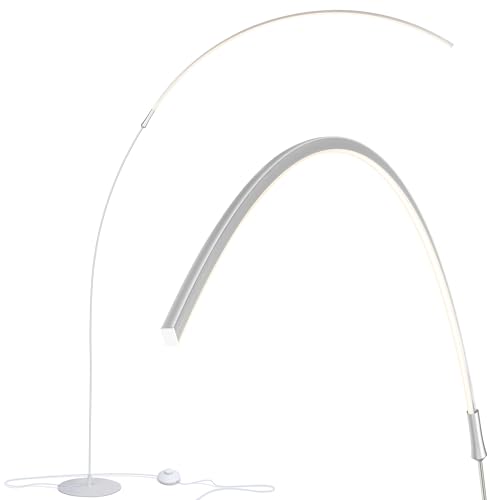
Best for Living room corners that need soft, dimmable ambient light
- Built-in dimmable LED with adjustable color temperature
- Torchiere-style upward-facing shade for soft ceiling-bounced light
- Weighted metal base for tip resistance
- No bulb-buying needed - LED is built in and long-lasting
- Dimming and color temperature adjust via an in-line switch
- Slim footprint suits smaller living rooms
- Built-in LED means the whole fixture is replaced, not just a bulb, once it eventually dims with age
Verdict: A practical, no-fuss torchiere that covers the most common living room use case - soft corner fill light - without needing a separate bulb purchase.

Best for Budget-conscious shoppers who still want dimmable LED light
- Dimmable torchiere design with built-in LED
- Compact base that fits tight corners
- One-touch dimmer switch
- Among the lowest-priced dimmable LED floor lamps available
- Lightweight and easy to move between rooms
- Simple one-switch operation
- Lighter base is less tip-resistant than heavier metal designs, so it's a better fit for low-traffic corners
Verdict: The lamp to buy when the goal is basic, reliable ambient light at the lowest reasonable price rather than a design statement.

Best for Living rooms where the lamp itself is meant to be a design feature
- Tree-style design with three separately controllable light heads
- Brushed nickel finish with fabric drum shades
- Multi-level lighting from one fixture
- Three independent lights give flexible ambient-to-bright control
- Upscale finish reads as a furniture piece, not just a lamp
- Good spread of light for larger seating areas
- Higher price point than a standard single-head torchiere
Verdict: Worth the extra cost for a living room that wants a genuine style statement along with flexible, zone-able light.

Best for Larger living rooms with higher ceilings that need a taller silhouette
- Taller-than-average profile suited to oversized rooms
- Sturdy weighted base
- Classic shade shape that pairs with most decor styles
- Proportions hold up well in rooms with 9-10 foot ceilings
- Stable base handles higher foot traffic
- Versatile, neutral styling
- Extra height can look out of place in a smaller or lower-ceilinged room
Verdict: The right pick specifically when a standard 60-inch floor lamp has looked stranded in a larger space - this one is sized to match.

Best for Throwing direct light over a specific sofa or reading chair
- Long curved arc arm that extends over seating
- Heavy marble-style weighted base for stability
- Adjustable arm height and shade angle
- Puts light exactly over a chair or sofa without needing a side table
- Heavy base counters the leverage of the extended arm
- Arm and shade angle can be fine-tuned for reading
- Needs floor clearance to swing the arm into position, so it doesn't suit tight layouts
Verdict: The best choice for a reading chair or sofa end that has no room for a side table but still needs direct, adjustable light.
Frequently Asked Questions
Do floor lamps use a lot of electricity?
Not with an LED bulb. A modern LED floor lamp bulb typically draws 9-15 watts to produce the same brightness an old 60-75 watt incandescent bulb produced, so running one for several hours a night costs only a few cents. ENERGY STAR-certified LED bulbs are the most efficient and longest-lasting option for a lamp that stays on for extended periods.
Can I use a smart bulb in any floor lamp?
In almost any standard lamp with a screw-in (E26) socket, yes. Smart bulbs from brands like Philips Hue or Govee work in ordinary floor and table lamp sockets and add dimming, scheduling and voice control without needing a lamp with built-in smart electronics. The one exception is lamps with a built-in in-line dimmer switch, which can sometimes conflict with a smart bulb's own dimming - check the bulb's compatibility notes first.
Is a torchiere or an arc floor lamp better for a living room?
A torchiere is the better all-purpose choice for ambient corner lighting in most living rooms, since it bounces soft light off the ceiling and takes up a small footprint. An arc lamp is worth choosing specifically when there's no side table available next to a sofa or chair and you need direct light thrown from overhead instead.
How much should I expect to spend on a good living room floor lamp?
A solid, stable, dimmable LED floor lamp from a known brand generally runs $40-$90. Below that range, base stability and shade quality are the first things to suffer; above roughly $150, most of the added cost goes toward designer materials and finishes rather than better light output.