Recessed Lighting & Downlights: Complete Guide
Comprehensive technical analysis of sizing, materials, installation requirements, and manufacturer standards for recessed lighting & downlights.

Recommended Products
See the full ranking →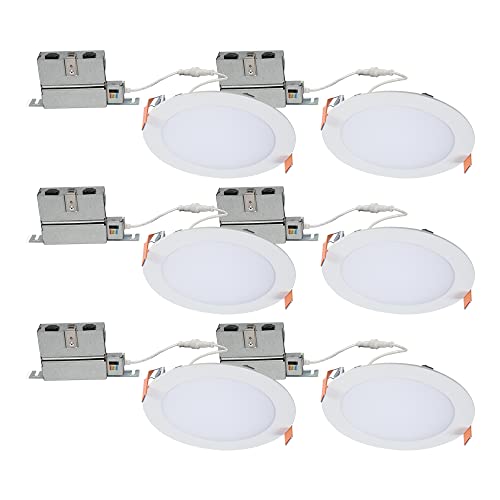


Recessed lighting (also called can lighting or downlighting) sits flush inside the ceiling, with only the trim and lens visible from below. Unlike a ceiling fan or a hanging fixture, it disappears into the architecture, which is why it is the default choice for kitchens, bathrooms, hallways, basements, and any room where a clean, low ceiling line matters more than a decorative fixture.
Every recessed fixture has two parts: the housing (the metal or plastic can that sits in the ceiling cavity, or the light engine itself on modern canless units) and the trim (the visible ring, baffle, or lens). Older installations used a separate housing and swappable trim; most products sold today are integrated LED units that combine the light source, driver, and trim into one part.
New Construction vs. Remodel Housings
If the ceiling is open (new build, addition, or gut renovation), a new-construction housing gets nailed or clipped to the joists before drywall goes up. If you are adding lights to a finished ceiling, you need a remodel (old-work) housing that clips to the back of the drywall through a cut hole - no attic access is needed for the housing itself, though the electrical wiring still has to reach each location.
IC-Rated and Airtight Housings
Any recessed housing that will be touched by insulation must be IC-rated (insulation contact). A non-IC-rated housing needs several inches of clearance from insulation to avoid overheating, which is rarely practical in a real attic. Look for IC-rated and, ideally, airtight (AT) on the spec sheet - airtight housings reduce the conditioned-air leaks that recessed lights are notorious for, which matters for both energy bills and preventing attic condensation.
The market has largely shifted to canless (also called slim or wafer) LED recessed lights. Instead of a deep metal can, a thin junction box a couple of inches deep sits in the ceiling, and a flat light disc mounts directly to it. Canless fixtures are faster to install, work well in shallow joist bays, and eliminate the bulb-and-socket connection that eventually fails. Traditional can-and-trim setups still make sense when you want to change the look later (swap a baffle trim for an adjustable gimbal trim) or when you are matching an existing can size in an older home.
4-inch fixtures throw a tighter, more focused pool of light and suit small rooms, hallways, and accent lighting. 6-inch fixtures spread more light per fixture and are the standard choice for general ambient lighting in kitchens, living rooms, and basements. As a rule of thumb, fewer 6-inch lights will light a room as evenly as more 4-inch lights, and 6-inch housings are also easier to source with both IC and airtight ratings.
Look at lumens, not watts. Most modern recessed LEDs are labeled with a wattage-equivalent (for example, 65W equivalent) alongside actual lumen output, typically 600-1,000 lumens per 6-inch fixture. For a kitchen or task area, aim for 4000K-5000K (bright white or daylight); for living rooms and bedrooms, 2700K-3000K (soft white) feels warmer and more relaxed. Many current LED recessed lights are selectable-CCT, meaning a small switch on the housing lets you pick the color temperature after installation - useful if you are not sure which look you want.
Almost all quality recessed LEDs are dimmable, but the fixture and the dimmer have to be compatible. Standard incandescent dimmers often cause flicker or a limited dimming range with LEDs; a dimmer designed for LED loads, such as those from Lutron, gives smoother results.
A fixture installed above a bathtub or shower, in a soffit, or under a porch roof needs a UL damp-location or wet-location listing, not a standard dry-location rating. Damp-rated fixtures tolerate humidity and occasional moisture; wet-rated fixtures are required anywhere they could be rained on directly. Check the housing's listing before buying if the location is anything other than a dry interior ceiling.
Getting the spacing right is the difference between even, comfortable light and a room full of hot spots and dark corners. As a starting point, general ambient layouts typically space 6-inch recessed lights about 4 to 6 feet apart and roughly 2 to 3 feet in from walls, then adjust based on ceiling height and whether the lights are doing ambient, task, or accent work.
Recessed lighting involves running or extending circuit wiring, working inside ceiling cavities, and often working near insulation and framing. Always turn off the power at the breaker before touching any wiring or existing fixture, and confirm it is off with a non-contact voltage tester. Adding new circuits, running new cable through walls or attics, or working with older ungrounded wiring is a job for a licensed electrician - and in most US jurisdictions, new lighting circuits require a permit and inspection. If you are ever unsure whether a circuit is safely rated for the fixtures you are adding, stop and call a professional rather than guessing.
For simple swaps - replacing a bulb, trim, or a canless retrofit in an existing, correctly wired housing - most confident DIYers can do the work safely once the power is off. For anything involving new boxes, new cable runs, or unfamiliar older wiring, hire a licensed electrician.
Go Deeper
Detailed companion guides for recessed lighting & downlights.
Recessed Lighting Spacing: How Many Can Lights You Need
Recessed lighting spacing calculator method: divide ceiling height by two, then size the number of can lights by room type and target lumens.
Canless vs Can Recessed Lighting: Which Should You Buy
Canless vs can recessed lighting compared: installation, bulb swaps, trims, and cost, so you know which downlight type to buy for your ceiling.