
How to Pick the Right Ceiling Fan Size
The single most common ceiling fan mistake is buying by looks first and size second. A fan that is too small for a room barely stirs the air, while one that is too large can feel overpowering, look out of proportion, and waste energy moving more air than the space needs. Sizing a ceiling fan really comes down to two numbers: the blade span (the diameter of the circle the blades sweep) and the room's square footage. Ceiling height and mounting style matter too, but square footage is where you start.
Blade Span by Room Size
Use this chart as your starting point, then adjust up if the room has high ceilings, an open floor plan, or gets direct afternoon sun.
| Room Size (sq ft) | Recommended Blade Span | Typical Rooms |
|---|---|---|
| Up to 75 sq ft | 29-36 inches | Bathroom, laundry room, walk-in closet, small nook |
| 75-144 sq ft | 36-42 inches | Small bedroom, home office, breakfast nook |
| 144-225 sq ft | 44-50 inches | Standard bedroom, dining room |
| 225-400 sq ft | 50-54 inches | Large bedroom, living room, den |
| 400+ sq ft | 56-72 inches, or two fans | Great room, open-concept living/kitchen, primary suite |
To find your square footage, multiply the room's length by its width in feet. A 12 x 14 ft bedroom is 168 sq ft, which lands in the 44-50 inch range.
Blade Span Isn't the Whole Story: Airflow (CFM) Matters Too
Two fans with the same blade span can move very different amounts of air. Airflow is measured in CFM (cubic feet per minute), and ENERGY STAR publishes efficiency benchmarks that make it easy to compare fans on more than just size. As a rough guide, look for a combined CFM across all speeds of at least 1,000-3,000 for small rooms and 4,000-6,000 or more for great rooms and large open spaces. A higher-CFM motor on a correctly sized fan will feel noticeably more effective than a bigger blade span paired with a weak motor.
Ceiling Height and Mounting Type
How you mount the fan affects both safety and performance:
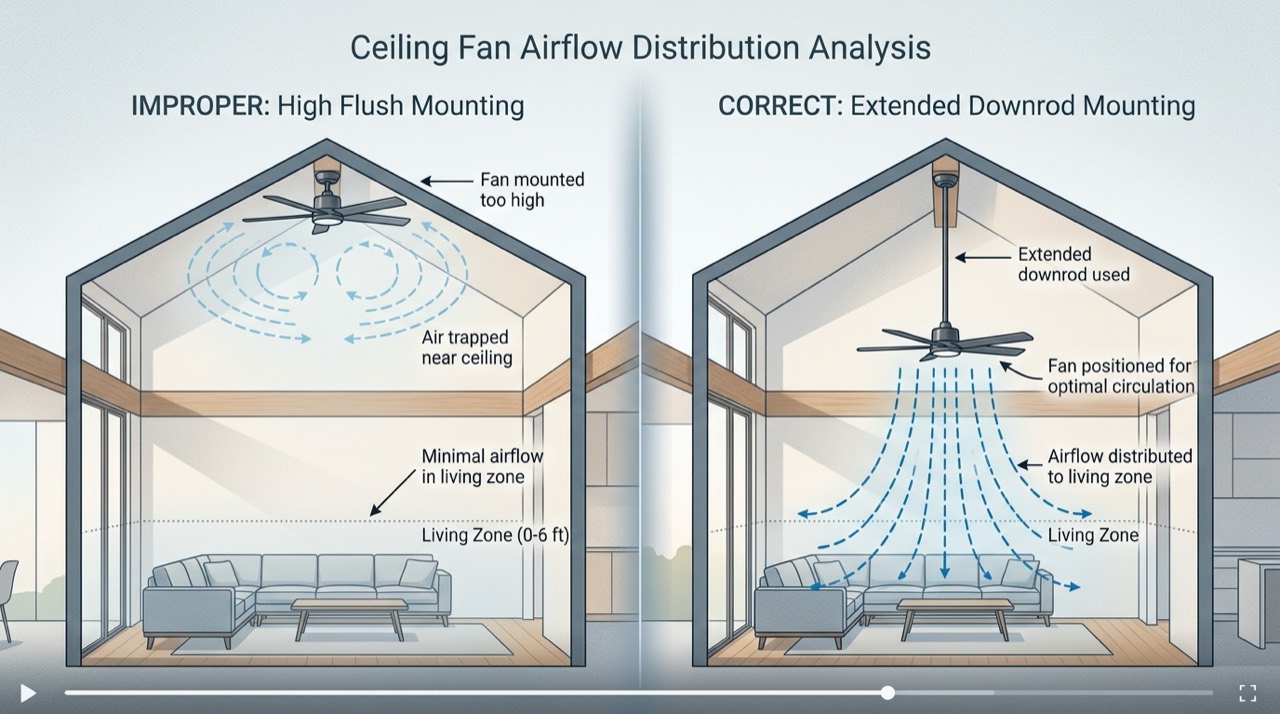
- Standard downrod mount: Best for ceilings 9 feet and higher. The downrod drops the fan to the ideal height, with blades roughly 8-9 feet above the floor for optimal air circulation.
- Flush mount (hugger): Used on ceilings under 8 feet, where a downrod would bring the blades too close to head height. Hugger fans typically move slightly less air than a downrod-mounted fan of the same blade span.
- Sloped-ceiling mount: A specialized downrod and mounting bracket are needed for vaulted or angled ceilings so the blades stay level.
Regardless of mounting style, most U.S. building codes and fan manufacturers require a minimum of 7 feet of clearance between the floor and the blades, and at least 18-24 inches of clearance between the blade tips and any wall or sloped ceiling. Check the fan's UL listing and the manufacturer's installation manual for the exact figures for your model.
Large and Open-Concept Rooms
Once a room passes roughly 400 square feet, a single fan, even a large one, often cannot circulate air evenly across the whole space. Two moderately sized fans spaced evenly apart, rather than one oversized fan in the center, typically move air more evenly through a great room, open kitchen-living area, or long primary bedroom. As a starting point, space multiple fans so each one is centered over roughly 200-300 square feet, and keep at least a few feet between blade tips.
Outdoor, Covered Patio, and Damp Areas
Fan size rules stay the same outdoors, but the fan itself needs the right UL rating for the location. Look for a wet-rated fan for spots exposed to direct rain or sprinklers, and a damp-rated fan for covered porches and patios that stay dry but see humidity. A standard indoor fan installed outdoors can corrode, short out, or void its warranty.
A Note on Safety
Ceiling fans are hardwired electrical fixtures, and choosing the right size is only half the job; mounting it safely is the other half. Before removing an old fixture or installing a new fan, always turn off power to the circuit at the breaker and confirm it's off with a non-contact voltage tester. Ceiling fans are heavier than standard fixtures and vibrate as they spin, so they need a fan-rated electrical box, not a standard light-fixture box, to handle the extra weight. If you're adding a new circuit, aren't confident identifying wires, or have any doubt about the existing box or wiring, hire a licensed electrician. A fan that isn't properly supported or wired is a fire and fall hazard, not just an inconvenience.
Bottom Line
Start with your room's square footage to land on a blade span range, then check the fan's CFM rating so you're not buying by diameter alone. Match the mounting style to your ceiling height, confirm the fan carries the right UL wet or damp rating for outdoor spots, and leave any wiring or mounting you're unsure about to a licensed electrician.