Bathroom Exhaust Fans: Complete Guide
Comprehensive technical analysis of sizing, materials, installation requirements, and manufacturer standards for bathroom exhaust fans.

Recommended Products
See the full ranking →

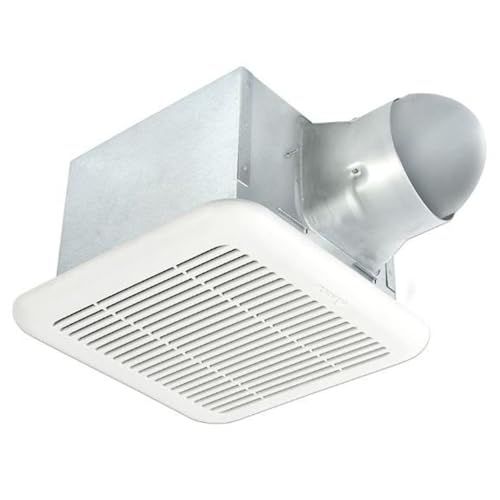
A bathroom exhaust fan isn't a comfort extra — it's moisture control. A hot shower dumps a large amount of water vapor into the air, and if that vapor has nowhere to go, it condenses on mirrors, windows, and cabinet backs, and worst of all inside wall and ceiling cavities where it feeds mold and slowly rots framing. A correctly sized, correctly vented fan clears that moisture before it becomes a problem and pulls out odors along the way. Most US building codes require mechanical ventilation in any bathroom without an operable window for exactly this reason.
The trouble is most homeowners inherit whatever fan came with the house, and a large share of those units are undersized, too loud to actually run for the full recommended cycle, or vented into an attic instead of outside — all of which quietly defeats the purpose. Getting the specs right is a one-time decision that pays off for the life of the fan.
Fan capacity is measured in CFM — cubic feet of air moved per minute. The baseline rule of thumb, used by most manufacturers and referenced by the Home Ventilating Institute (HVI), is about 1 CFM per square foot of bathroom floor area, with a practical floor of 50 CFM even for small powder rooms. A 60 square foot bathroom calls for roughly a 60 CFM fan at minimum.
Two adjustments push that number higher. Add capacity for fixtures — roughly 50 CFM for a standard tub or shower and 100 CFM for a separate enclosed toilet room — on top of the base square-footage figure. Then add for duct resistance: every extra foot of duct run and every 90-degree elbow reduces real-world airflow below the fan's rated number, so a long or elbow-heavy run to the exterior calls for sizing up rather than buying to the bare minimum. When your calculation lands between two sizes, round up — an oversized fan just cycles a bit less, while an undersized one never really clears the room.
CFM tells you how much air a fan moves; sones tell you how loud it is while doing it. A sone is a measure of perceived loudness, and it isn't linear — 2 sones sounds roughly twice as loud as 1 sone. For reference, 1.0 sone is about the sound of a quiet refrigerator, while older builder-grade fans commonly run 4.0 sones or louder, loud enough that most people never actually run them the full recommended time.
This matters more than it sounds like it should, because a fan that annoys the household gets switched off early, and moisture removal depends on runtime, not just airflow capacity. HVI-certified quiet fans in the 0.3 to 1.5 sone range are worth the modest price premium for exactly this reason — a quieter fan is a fan that actually gets used long enough to do its job.
Look for the ENERGY STAR label when shopping. To qualify, bathroom fans must move air efficiently, measured in CFM per watt, and meet a maximum sone rating, so an ENERGY STAR fan is effectively pre-screened for the "quiet and efficient" combination most homeowners want. ENERGY STAR-certified fans typically use 60 to 70 percent less energy than non-certified builder-grade models while moving comparable or better airflow, and since a bathroom fan can run for extended stretches on a timer or humidity sensor, that running-cost difference adds up over its lifespan.
A growing share of bathroom fans now include a built-in humidity sensor that automatically switches the fan on when relative humidity rises above a set threshold and off once it drops back down — no one has to remember to flip a switch before or after a shower. This solves the most common real-world failure mode: a fan that would work fine but simply doesn't get run long enough. Some models pair the humidity sensor with a motion sensor so the fan also runs briefly whenever someone enters the room, or add multi-speed operation that boosts to a higher CFM setting automatically once humidity spikes. These features cost more up front but are worth prioritizing in a household where a fan tends to get forgotten.
A bathroom fan is only as good as where its exhaust actually goes. The duct must terminate outside the building envelope — through a roof cap, a wall cap, or a soffit vent — never into an attic, a soffit that just recirculates into the attic space, or a crawlspace. Venting moist air into an unconditioned attic is one of the most common and most damaging mistakes in bathroom fan installations: it condenses on the underside of the roof deck and creates hidden mold and wood-rot problems that can go unnoticed for years.
Match the duct diameter to the fan's rating — most residential bathroom fans call for 4-inch round duct, with higher-CFM units sometimes requiring 6-inch duct to avoid choking airflow. Use rigid or semi-rigid metal duct where practical rather than long runs of flexible duct, since flex duct's ribbed interior increases resistance and can measurably cut real-world CFM below the fan's rated output. Keep the run short and straight, insulate any duct passing through unconditioned attic space to prevent condensation inside the duct itself, and confirm the exterior termination has a functioning backdraft damper so outside air isn't pulled back in when the fan is off.
Bathroom exhaust fans are hardwired fixtures on a live circuit. Before doing anything at the fan or its switch, turn off power at the breaker — not just the wall switch — and confirm the circuit is dead with a non-contact voltage tester. A wall switch only interrupts part of the circuit; the incoming line can still be energized.
A straightforward like-for-like swap onto existing housing, wiring, and ductwork is manageable for a confident DIYer who follows that safety step. But hire a licensed electrician if there's no existing fan housing and one needs to be added, the job requires cutting into finished ceiling or running new cable, your home has aluminum or knob-and-tube wiring, or you're simply not confident identifying and connecting the wires safely. Many jurisdictions also require a permit for anything beyond a direct replacement, so check with your local building department first — a licensed electrician's visit is inexpensive insurance next to a wiring mistake sealed inside a wall.
Even a well-chosen fan loses performance if the grille and housing clog with dust and lint, which restricts airflow and can make the motor run hotter and louder over time. Vacuum the exterior grille every few months, and pull the housing cover for a deeper clean of the blades and motor once or twice a year. Check the exterior duct termination annually to confirm the backdraft damper still opens freely and hasn't been blocked by debris or insects — a stuck damper quietly defeats even a correctly sized, correctly vented fan.
Go Deeper
Detailed companion guides for bathroom exhaust fans.
What a Sone Rating Means on a Bathroom Exhaust Fan
What is a sone rating on bathroom fans? A plain guide to how sones measure fan loudness, what counts as quiet, and how to read the label.
How to Clean a Bathroom Exhaust Fan the Right Way
How to clean a bathroom exhaust fan step by step: cut power, remove the cover, vacuum the blower, wipe it down, and clear the outside vent.