

Getting Bathroom Vanity Lighting Right
Vanity lighting has one job most other fixtures don't: it has to make a face look accurate. You shave, apply makeup, check for a rash, or trim a beard in this light, so shadows and off-color light show up as real mistakes — a missed patch, uneven foundation, a nick you didn't see coming. Getting it right is mostly about three things: where the light comes from, how bright it is, and what color it renders.
Light the face, not the ceiling
The single biggest lighting mistake in bathrooms is relying on one downlight or a recessed can directly above the mirror. Overhead-only lighting throws shadows down across the eyes, under the nose, and under the chin — exactly the areas you're trying to see clearly. It's the same problem as bad stage lighting.
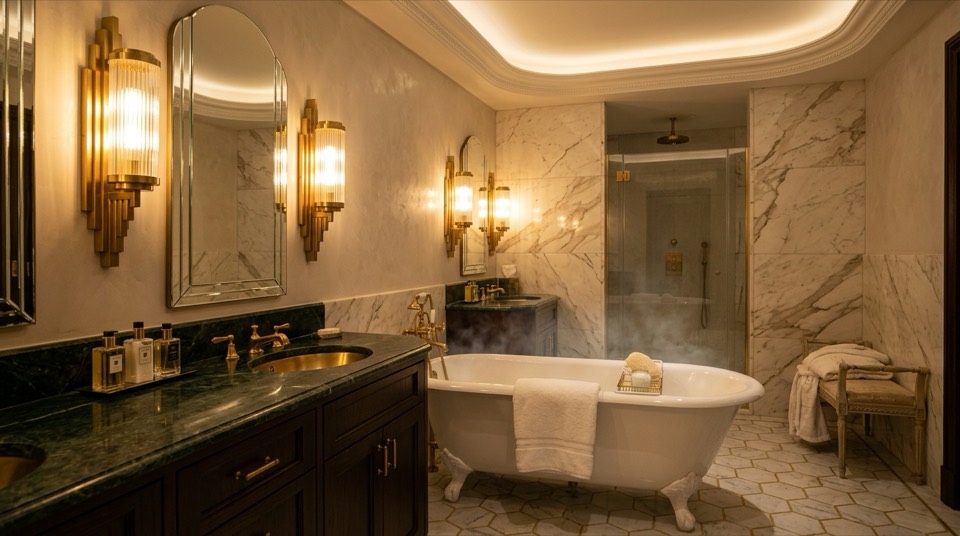
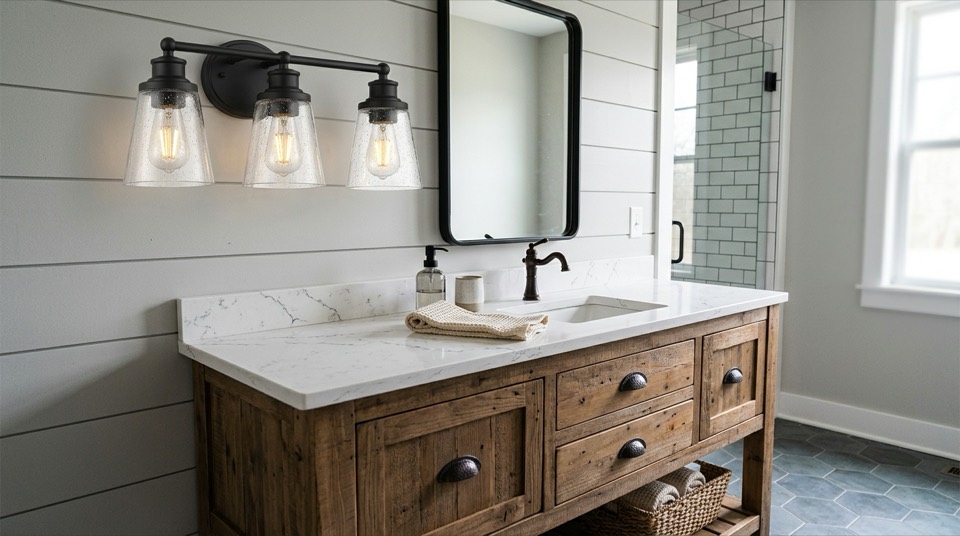
The fix is side lighting. Two vertical sconces or bar lights mounted on either side of the mirror, roughly at eye level (about 60 to 66 inches from the floor to the center of each fixture, adjusted for the household's height), light the face from both sides and cancel out those shadows. If the mirror is too wide for two side sconces to flank comfortably, a light bar mounted directly above or across the top of the mirror is the next best option — it's not as flattering as side lighting, but it beats a single ceiling can by a wide margin.
Many well-lit bathrooms combine both approaches: a vanity-specific fixture (sconces or a bar) for task lighting at the mirror, plus a separate ceiling fixture or recessed lighting layout for general room light. That combination — sometimes called layered lighting — means you're not trying to make one fixture do the job of ambient light, shower light, and task light all at once.
How much light is enough
For task lighting at a mirror, look for a combined output in the range of roughly 1,500 to 2,000 lumens across the vanity fixture(s) — brighter than most people expect a "light" to be, because task lighting for grooming needs more punch than a lamp on a side table. On the box or product listing, this is usually expressed as total lumens or as a wattage-equivalent (for example, a fixture rated for three 60-watt-equivalent LED bulbs is a common target for a mid-size vanity).
Color rendering matters as much as brightness. Look for a CRI (Color Rendering Index) of 90 or higher. A low-CRI bulb can be bright enough and still make skin tones look grey, foundation look mismatched, or a shirt look like the wrong shade of blue. CRI ratings aren't always printed prominently, but they're increasingly listed on LED packaging and product pages — it's worth checking before buying.
Damp and wet ratings aren't optional
Bathrooms are damp environments, and anything near a shower or tub falls under stricter electrical safety rules. Fixtures are rated for specific locations:
- Dry-rated fixtures are meant for spaces with no moisture exposure — not appropriate for most bathroom locations.
- Damp-rated fixtures can handle humidity and occasional moisture (typical for a vanity fixture a few feet from a shower).
- Wet-rated fixtures are built to handle direct water spray and are required for anything inside or directly above a shower or tub enclosure.
Color temperature, briefly
Color temperature, measured in Kelvin, affects how "warm" or "cool" the light looks and how accurately it renders skin tones and colors. For most vanity applications, a neutral range of roughly 3000K to 4000K strikes the right balance between flattering and accurate — warm enough not to look clinical, cool enough to render color and detail well for grooming tasks. (More detail on this is covered in the dedicated FAQ on color temperature for bathroom lighting.)
Dimmers, switches, and smart controls
A dimmer on the vanity circuit is a genuinely useful upgrade — full brightness for grooming, a lower setting for a 2am trip that doesn't wake up the whole household. Not every LED fixture is dimmer-compatible, so check compatibility before pairing a dimmer switch with LED vanity lights; mismatched dimmers can cause flickering or buzzing.
Smart bulbs and smart switches (tunable-white options in particular) let a household shift between a cooler, brighter setting for makeup or shaving and a warmer, dimmer setting for evening use, without swapping bulbs. Any smart switch replacing an existing wall switch is still a wiring job — see the electrical safety note below.
Working with a mirror or medicine cabinet
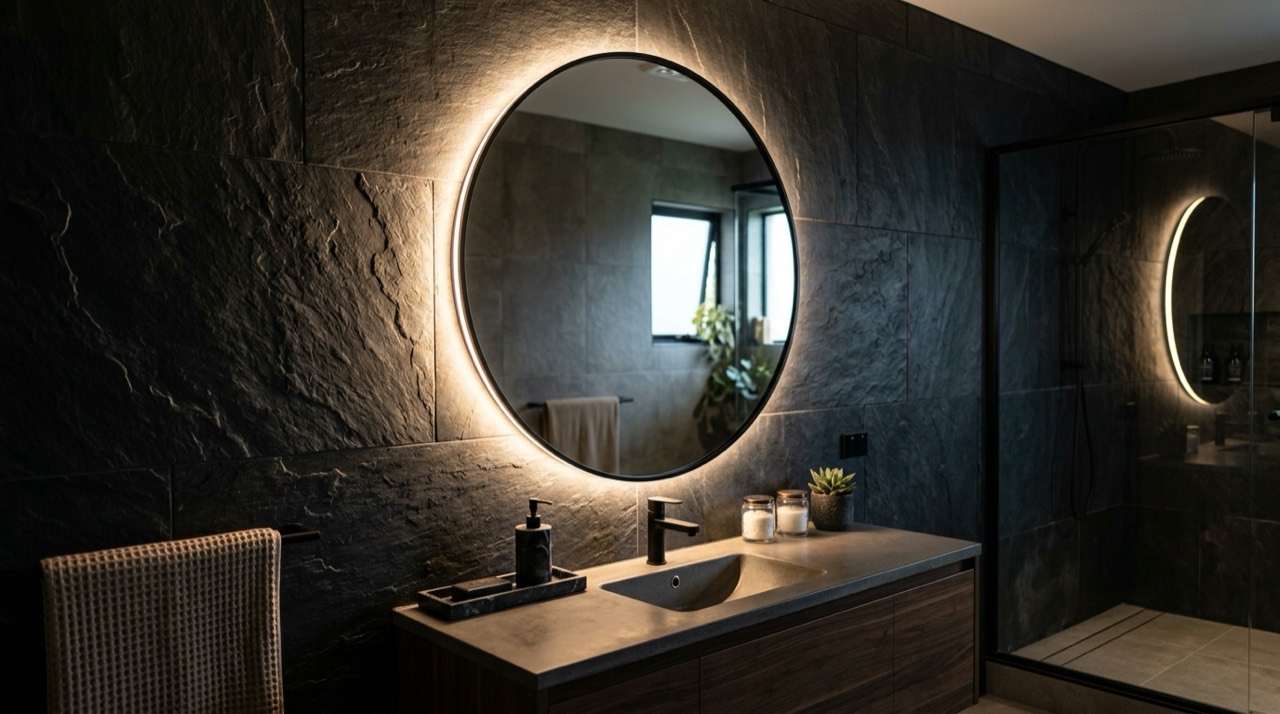
Lit mirrors and lighted medicine cabinets fold the light source into the mirror itself, which can simplify a small bathroom's layout by removing the need for separate sconces. These are worth considering during a remodel, but they're generally not a simple swap-in for an existing plain mirror — they need their own electrical connection, so plan the wiring before the mirror is chosen, not after.
Electrical safety
Any of this that involves running new wiring, adding a switch, or hardwiring a fixture is not a casual DIY swap. Always turn off power at the breaker before working on any fixture or switch, and confirm it's off with a non-contact voltage tester before touching wires. For new circuits, moved switch locations, or anything near a wet zone, hire a licensed electrician — bathroom wiring is subject to local code requirements (including GFCI protection) that a licensed pro will know and pull permits for. If there's any doubt about whether a fixture location or wiring change is compliant, that's the signal to call a professional rather than guess.