Best Bathroom Exhaust Fans With Light And Heater
Best Bathroom Exhaust Fans With Light And Heater, ranked from aggregated owner ratings and reviews, not first-hand testing. Real pros, cons, and who each pick is best for.

Our Top 3 Picks
Quick Comparison
| Product | Best for | Buy | |
|---|---|---|---|
| 9093WH Ceiling Heater, Fan & Light Combo | Best Overall | See Amazon | View |
| WhisperWarm FV-11VHL2 Fan/Heater/Light Combination | Best for Quiet Operation | See Amazon | View |
| BreezRadiance RAD80L Fan/Heater/LED Light | Best Value | See Amazon | View |
| QTXE110FLT Ultra Silent Heater/Fan/Light/Nightlight | Best for Large Bathrooms | See Amazon | View |
| 7141-80 Bathroom Exhaust Fan with LED Light | Best Budget Fan + Light (No Heater) | See Amazon | View |
How to Choose a Bathroom Fan with Light and Heater
Shopping for a heater/fan/light combo means balancing four separate specs instead of one, since you're effectively buying three appliances in a single housing. Here's what actually matters.
CFM (airflow)
Match the fan portion to your bathroom's square footage using the 1-CFM-per-square-foot rule with a 50 CFM minimum, and check whether your layout has a separate enclosed shower or tub that calls for an additional allowance under HVI guidance. A bigger number on the box isn't a free upgrade — an oversized fan in a small, well-sealed bathroom can whistle or make the door hard to open while it runs.
Heater wattage and circuit compatibility
Compare the heater element's rated wattage, and — more importantly — confirm what the installation manual specifies for circuit requirements before you buy, not after. A 1,200-1,500-watt heater assumed onto a shared 15-amp circuit with existing lighting and outlets can trip breakers repeatedly or, worse, overload wiring that isn't rated for the load. If your bathroom doesn't already have a dedicated 20-amp circuit run to the fixture location, budget for an electrician's visit as part of the purchase, not an afterthought.
Light: type, lumens, and Kelvin
LED light modules built into the housing, rather than a screw-in incandescent socket, run cooler, last longer, and use a fraction of the power. Compare lumen output to your room size, and check color temperature: 2700-3000K reads as warm and residential, while 3500-4000K is a crisper, more task-oriented white common around vanities. Some combo units add a small nightlight LED on its own low-draw circuit, which is worth having in a bathroom used at night.
Sone rating
Quieter combo units run in the 0.5-1.5 sone range; budget units can run 3 sones or higher. If a quiet bathroom matters to you — next to a nursery or a primary suite — prioritize the sone spec over CFM headroom you don't actually need.
Housing depth and duct size
Retrofit installations are constrained by existing joist depth and duct routing. Measure the housing depth of any replacement candidate against your current fixture's cutout before ordering, and confirm the duct collar size (commonly 4 inches) matches your existing ductwork so you're not adapting a transition piece into a tight joist bay.
Certifications worth checking
ENERGY STAR certification applies to the fan and light performance, not the heater. UL listing on the whole assembly indicates it's been tested as a system, which matters more here than on a simple fan given the heat output and amperage involved. If the fixture sits above a tub or shower area, confirm it carries the damp- or wet-location rating required for that placement under most electrical codes.
Who should skip a heater/fan/light combo
If your bathroom is already served by central heating that keeps it comfortable, or your panel has no room for a new dedicated circuit without a costly panel upgrade, a simpler fan-and-light unit paired with a separate wall or ceiling heat lamp on existing wiring may be the more practical, less invasive path. Renters, and anyone not planning to stay in a home long enough to justify new circuit work, are also usually better served skipping the heater function and focusing on ventilation performance alone.
None of this needs to be guesswork before you buy. Most manufacturers publish the full spec sheet, including exact heater wattage and required circuit amperage, on the product page itself — read that page before adding anything to the cart, and if it doesn't spell out circuit requirements clearly, treat that as a reason to keep researching rather than assume the worst case won't apply to your bathroom.
Full Ranking, Reviewed

Best for Most bathrooms that need heat, ventilation, and light from one classic combo unit.
- Radiant heater element in the 1,250-1,500 watt range for quick warm-up
- Integrated exhaust fan sized for small to mid-size bathrooms
- Incandescent light socket built into the same housing
- Ceiling-mounted housing designed to fit standard joist spacing
- Widely available at home centers with well-documented parts and manuals
- Straightforward three-function design that's easy to wire to separate switches
- Lower upfront cost than premium quiet-fan combos
- Incandescent bulb socket only, no built-in LED module
- The heater portion typically needs its own dedicated 20-amp circuit, which can mean added electrical work
Verdict: A dependable, no-frills combo that covers heat, fan, and light without a premium price tag, as long as your panel can support a dedicated circuit.

Best for Buyers who want a heater/fan/light combo that doesn't sound like a vacuum.
- 110 CFM fan rated for a notably low sone level versus typical heater-fan combos
- Dual heater elements for radiant warmth
- Built-in thermal cutoff for the heater
- Fan portion built to ENERGY STAR performance specs
- Meaningfully quieter operation than basic heater-fan units
- Higher CFM rating comfortably handles larger bathrooms
- Panasonic's long track record in bath ventilation hardware
- Costs noticeably more than entry-level combo units
- Still typically requires a dedicated circuit for the heater function
Verdict: Worth the premium if fan noise is your main complaint about existing bathroom fixtures.

Best for Mid-size bathrooms that want a built-in LED light instead of a bulb socket.
- 80 CFM fan suited to average-size bathrooms
- Radiant heater element integrated into the housing
- Factory LED light module rather than a separate bulb
- Multi-speed motor aimed at lower operating noise
- LED module means no bulb replacements over the fixture's life
- Reasonably quiet for a heater-equipped combo
- Complete heat/light/fan kit at a mid-range price point
- LED module isn't independently dimmable on base trims
- Heater load still calls for its own high-amp circuit, same as competitors
Verdict: A sensible middle ground between the budget Broan-NuTone and the pricier Panasonic, especially if you want LED lighting out of the box.
Best for Larger primary bathrooms that need more airflow plus heat, light, and a nightlight.
- 110 CFM fan positioned in Broan-NuTone's Ultra Silent line
- Integrated LED light plus a separate low-draw LED nightlight
- Radiant heater element sized for larger rooms
- Multi-function design intended for four-way switch control
- Higher CFM handles larger bathrooms and en-suites well
- Nightlight function is genuinely useful without waking the household
- Quieter engineering than Broan-NuTone's entry-level combos
- Premium price relative to basic combo units
- Four functions typically call for a four-gang switch box, which adds wiring complexity
Verdict: The step-up Broan-NuTone pick when one bathroom needs to do more — more air, more light, and a nightlight — without moving to a different brand.
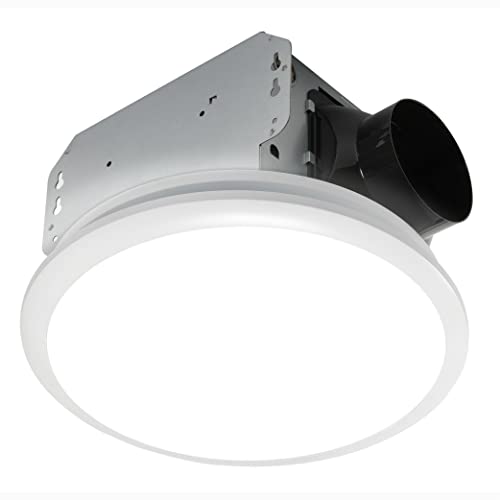
Best for Shoppers who only need fan-plus-light and would rather keep or add a separate heat source on its own wiring.
- 80-110 CFM depending on the specific model
- Integrated LED light panel
- Low sone rating for a budget-tier fan
- Retrofit-friendly housing sized for common ceiling cutouts
- Inexpensive relative to any heater-equipped combo
- Easy swap for an existing fan/light housing
- No heater means no dedicated-circuit requirement to plan around
- No heater function at all — not a fit if warmth is the actual goal
- You'll need a separate heat lamp fixture and switch if you want heat later
Verdict: The right call when ventilation and light are the only jobs you need done, and you'd rather avoid heater-related electrical work entirely.
Frequently Asked Questions
How many CFM do I need for a bathroom fan with heater?
Use the HVI/ENERGY STAR baseline of 1 CFM per square foot of floor area, with a 50 CFM minimum even in small bathrooms. Add the fixed CFM allowances HVI recommends for an enclosed shower or a separate water closet if your layout has one, and avoid oversizing a small, tightly sealed room or the fan can struggle to pull replacement air under the door.
Do bathroom heater fans need their own electrical circuit?
Most do. A heater element rated 1,200-1,500 watts can approach the safe limit of a standard 15-amp circuit on its own, so manufacturer instructions typically require a dedicated circuit — often 20-amp — separate from existing bathroom outlets and lighting. Confirm your panel has room before buying, and have a licensed electrician run new circuit wiring if it doesn't.
What's the difference between a heat lamp and a heater/fan/light combo?
A heat lamp is a stand-alone infrared bulb fixture, sometimes with multiple bulbs, that only radiates warmth and is wired independently of ventilation. A heater/fan/light combo integrates a resistive heating element, an exhaust fan, and a light or LED module into one ceiling housing, typically on three separate switches, covering ventilation and lighting duties a heat lamp doesn't.
Can I install a bathroom heater/fan/light combo myself?
If it's a like-for-like swap onto existing wiring that already matches the new unit's electrical requirements, an experienced DIYer can often handle it. If the new unit needs a dedicated circuit that doesn't already exist, that's new-circuit work requiring a permit in most areas — hire a licensed electrician rather than tapping into a circuit that isn't rated for the load.