

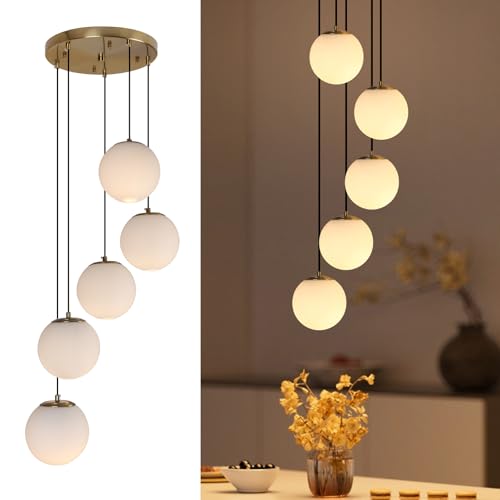



For a dining room, size the chandelier two ways. To suit the room, add its length and width in feet and read that number as inches of diameter (a 12-by-14-foot room suggests about 26 inches). To suit the table, make the chandelier about one-half to two-thirds the table's width.
Two quick sizing methods
Chandelier sizing comes down to two questions: does it fit the room, and does it fit the table? Use both.
Method 1: Size to the room
Add the room's length and width in feet, then read that total as inches of chandelier diameter.
- A 10-by-12-foot room: 10 + 12 = 22, so about a 22-inch diameter.
- A 12-by-14-foot room: about 26 inches.
- A 14-by-16-foot room: about 30 inches.
Method 2: Size to the table
For a chandelier hung over a dining table, its diameter should be roughly one-half to two-thirds the width - the shorter dimension - of the table.
- A 36-inch-wide table: aim for about 18 to 24 inches.
- A 42-inch-wide table: about 21 to 28 inches.
- A 48-inch-wide table: about 24 to 32 inches.
When the two methods disagree
The room method and the table method won't always land on the same number. When they differ, favor the table method for a fixture hung directly over the table, then sanity-check it against the room so it doesn't feel too small in a large space. In a big room with a modest table, a slightly larger fixture - or two smaller ones in a row - can bridge the gap.
Don't forget the fixture's own height
Diameter isn't the only dimension. A chandelier also has a vertical size, and taller ceilings want taller fixtures so they don't look stunted.
- A rough guide: allow about 2.5 to 3 inches of fixture height for each foot of ceiling height.
- For a 9-foot ceiling, that's roughly a 22 to 27-inch-tall fixture.
Long tables and rectangular rooms
Round or square chandeliers suit round and square tables. For a long rectangular table, a single round chandelier can look undersized. Better options:
- A linear or rectangular chandelier that mirrors the table shape.
- Two or three smaller fixtures spaced evenly down the table's length.
Match the light output to the room
Size is visual, but a dining room also needs the right amount of light. A large decorative chandelier with dim bulbs can still leave the table gloomy.
- Plan enough total brightness for comfortable dining, and put the chandelier on a dimmer so it can go from bright to intimate.
- A warm color temperature (2700K-3000K) flatters food and faces.
- A high CRI, ideally 90 or above, makes the table setting look its best.
- Layer with other sources - wall sconces, recessed lights, or a buffet lamp - so the room isn't lit by the chandelier alone.
Style and visual weight
Two chandeliers of the same diameter can feel very different. An open, airy fixture with thin arms reads smaller than a solid drum shade or a crystal-heavy design of the same width. In a small room, a visually light fixture can go slightly larger without overwhelming; in a big room, a substantial fixture holds the space better. Trust how it looks, not just the tape measure.
Quick sizing checklist
- Measure the room: length plus width in feet equals diameter in inches.
- Measure the table's width: chandelier equals one-half to two-thirds of it.
- Confirm at least 6 to 12 inches of clearance from each table edge.
- Choose a fixture height suited to the ceiling, about 2.5 to 3 inches per foot.
- For long tables, consider linear or multiple fixtures.
- Put it on a dimmer and check the light output, not just the size.
A note on installation
Chandeliers can be heavy, and they hang from a hardwired ceiling box.
- The electrical box must be rated to support the fixture's weight; many chandeliers require a fixture-rated, braced box.
- Turn off power at the breaker and verify it's dead with a non-contact voltage tester before wiring.
Get the diameter from the room-and-table math, match the height to your ceiling, confirm the clearances, and you'll land on a chandelier that fits both the table and the space around it.


