Best Outdoor And Landscape Lighting
Best Outdoor And Landscape Lighting, ranked from aggregated owner ratings and reviews, not first-hand testing. Real pros, cons, and who each pick is best for.

Our Top 3 Picks
Quick Comparison
| Product | Best for | Buy | |
|---|---|---|---|
| Design Pro LED Path Light | Best Overall | See Amazon | View |
| 8-Piece Low-Voltage LED Path Light Kit | Best Value | See Amazon | View |
| 5010 Series LED Landscape Path Light | Best Premium | See Amazon | View |
| Hue Lily Outdoor Spotlight | Best Smart Pick | See Amazon | View |
| Solar LED Landscape Spotlights (2-Pack) | Best Solar Option | See Amazon | View |
| Landscape LED Adjustable Well Light | Best for Uplighting Trees | See Amazon | View |
What to Look for When Choosing Outdoor and Landscape Lighting
Power Source: Low-Voltage, Solar, or Line-Voltage
Most residential landscape lighting runs on 12V low-voltage power from a transformer, which is safe to work with at the fixture end and easy to expand over time. Solar fixtures need no wiring at all but depend entirely on direct sun exposure. Line-voltage (120V) systems deliver more power over longer distances but should be installed by a licensed electrician.Weatherproofing and IP Ratings
Every fixture living outdoors needs a real weather rating, not just "outdoor use" printed on the box. Look for an IP65 rating or higher for path lights and spotlights, and a specific wet-location or burial rating for anything going into the ground, like a well light. Fixtures with no stated IP rating are a red flag.Lumens and Color Temperature, Not Just Wattage
LED landscape fixtures are usually described in lumens and a "wattage equivalent" rather than actual watts, since the real draw is much lower. For most yards, warm white in the 2700K–3000K range looks the most natural against plants, brick, and stone; anything above about 4000K starts to look like a security floodlight rather than an accent light.Beam Angle and Optics
A narrow spot beam suits uplighting a tree trunk or column; a wider flood beam suits washing a wall or a bed of shrubs. Better fixtures have interchangeable lenses or adjustable heads so a single fixture design can do both jobs.Fixture Material
Cast brass and copper fixtures develop a natural patina and resist corrosion for decades, which is why they dominate professional landscape lighting lines. Cast aluminum with a powder-coat finish is a solid mid-range option. Plastic housings are the cheapest but are also the first to chalk, crack, or yellow under UV exposure.Transformer Capacity and Cable Gauge
Add up the wattage of every fixture on a low-voltage run and stay under about 80% of the transformer's rated capacity, leaving room for future fixtures. For runs longer than roughly 100 feet, use 12- or 10-gauge cable instead of thin 16-gauge cable, or choose a transformer with multiple voltage taps — otherwise the fixtures farthest from the transformer will visibly dim.Smart and App Control
Smart low-voltage systems and smart bulbs let you schedule, dim, and group outdoor lights from a phone, and some tie into a home's existing smart-home ecosystem. This is a genuine upgrade over a basic mechanical timer, but it does add setup complexity and, in some cases, a hub requirement.Who Should Consider a Full Custom System
A landscape lighting designer or licensed electrician is worth the cost for a property with a lot of mature trees, a long driveway, or an entertaining area that needs a cohesive, layered plan — the upfront design work usually prevents an expensive re-do later.Who Should Skip a DIY Low-Voltage Kit
- Anyone needing new line-voltage circuits or trenching under a driveway or patio — that's an electrician's job, not a weekend project
- Renters who can't run permanent cable — solar or battery fixtures are the more realistic option
- Properties under an HOA with lighting covenants — check the rules before installing anything permanent, including uplighting aimed at a facade
The Bottom Line
Match the fixture type and power source to the job: low-voltage LED for anything that needs to look consistently good every night, solar for low-stakes accents in sunny spots, and a licensed electrician for anything touching household wiring.Full Ranking, Reviewed

Best for Whole-yard low-voltage path and accent lighting
- 12V low-voltage LED path light with integrated warm-white module
- Cast aluminum housing with a weather-resistant powder-coat finish
- Hooded design that directs light downward to cut glare
- Compatible with standard 12V transformers and Kichler's accessory lineup
- Solid metal build holds up to years of outdoor exposure
- Downward hood keeps glare and light trespass low
- Easy to expand into a full low-voltage system over time
- Higher per-fixture cost than plastic solar or big-box kit lights
Verdict: A dependable, well-shielded path light for anyone building a proper low-voltage system rather than a quick plug-in kit.

Best for A complete starter system for walkways and garden beds
- Includes 8 metal path lights, cable, and a compact transformer in one box
- Low-voltage 12V LED system
- Stake-mount installation for garden beds and walkways
- Widely available at home improvement retailers
- Complete kit at a lower price than buying components separately
- Simple stake-and-plug installation most homeowners can do themselves
- Easy to find replacement parts and add-on fixtures
- Included transformer has limited capacity for expanding much beyond the kit
Verdict: The most practical way to get a full low-voltage path lighting system without pricing out individual parts.

Best for A front entry or courtyard that needs a professionally designed look
- Machined brass or aluminum construction depending on finish
- High-output integrated LED engine
- Precision optics for even, glare-controlled downlight
- Built to the standard used in professional landscape lighting installs
- Premium materials that age well and resist corrosion
- Consistent, well-engineered light output across the line
- Long manufacturer warranty typical of professional-grade fixtures
- Significantly more expensive per fixture than big-box kits
Verdict: Worth it for a front yard or entry that needs to look professionally designed and last for decades, not just a season.
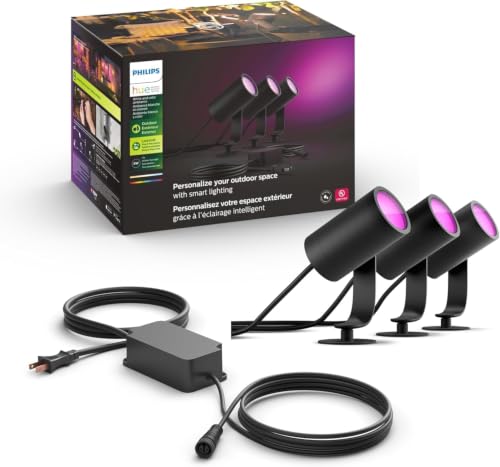
Best for App and voice-controlled uplighting for trees and facades
- App and voice control through the Hue ecosystem
- Dimmable, tunable-white LED, with color options in some kits
- IP65-rated weatherproof housing
- Expandable with additional Lily spotlights on one low-voltage run
- Full smart scheduling, dimming, and scene control from a phone
- Integrates with an existing Hue Bridge and smart home routines
- No separate smart plug or hub needed once the base kit is set up
- Requires a Hue Bridge and its own low-voltage power supply, raising the buy-in cost
Verdict: The easiest way to get real smart-home control over accent and uplighting without cobbling together smart plugs.

Best for No-wiring accent lighting in a spot with reliable direct sun
- Integrated solar panel and rechargeable battery, no wiring required
- Automatic dusk-to-dawn operation via a built-in photocell
- Adjustable, spike-mounted spotlight head
- IP65-rated weatherproof housing
- Zero wiring or transformer needed, ideal for rentals or quick installs
- Automatic operation with no timer to set
- Easy to reposition anywhere that gets direct sun
- Brightness and runtime drop noticeably in winter, shade, or extended cloudy stretches
Verdict: A reasonable accent light for a sunny spot where running cable isn't worth the effort, but not a substitute for low-voltage uplighting on a shaded tree.

Best for Flush, in-ground uplighting on a mature tree or column
- In-ground, flush-mount well light housing
- Adjustable, aimable LED module for uplighting
- Rated for wet locations and burial per manufacturer spec
- Low-voltage 12V operation
- Nearly invisible in the lawn during the day
- Genuinely wet-location rated for in-ground use
- Aimable head lets you fine-tune the uplight angle after installation
- Installation requires digging and leveling a housing sleeve, more labor than a stake light
Verdict: The right fixture specifically for uplighting a mature tree or architectural column without a visible fixture sitting in the lawn.
Frequently Asked Questions
How many landscape lighting fixtures do I need?
There's no fixed number — it depends on what you're highlighting, not the square footage of the yard. Count the actual focal points (entry, a few trees, a walkway, a water feature) and light those well rather than spacing fixtures evenly across the whole property.
Can I mix solar and low-voltage fixtures in the same yard?
Yes. Many yards use low-voltage for the fixtures that need to look bright and consistent every night — uplighting a tree, lighting a main path — and solar for secondary accents in sunny spots where running cable isn't worth the effort.
Do landscape lights need to be on a GFCI outlet?
Yes. The low-voltage transformer (or any line-voltage fixture) should plug into or be wired to a GFCI-protected outdoor circuit. This is standard practice for outdoor electrical equipment and is typically required by code.
How long do low-voltage LED landscape lights last?
Quality LED landscape fixtures commonly run tens of thousands of hours before the LED itself dims meaningfully — often well over a decade of typical nightly use. The housing and gasket quality tend to determine real-world lifespan more than the LED chip does.