Best Bladeless Fans And Air Circulators
Best Bladeless Fans And Air Circulators, ranked from aggregated owner ratings and reviews, not first-hand testing. Real pros, cons, and who each pick is best for.


Our Top 3 Picks
Quick Comparison
| Product | Best for | Buy | |
|---|---|---|---|
| Cool AM07 Air Multiplier Tower Fan | Best Overall | See Amazon | View |
| 660 Whole Room Air Circulator | Best for Whole-Room Airflow | See Amazon | View |
| TurboForce Power Motor Pedestal Air Circulator Fan | Best Value | See Amazon | View |
| Nomad One Pedestal Fan | Best Smart Pick | See Amazon | View |
| Wind Machine 3300 High Velocity Fan | Best for Garages and Large Spaces | See Amazon | View |
How to Choose a Bladeless Fan or Air Circulator
Before comparing specific models, decide which job you're actually buying for. A
bladeless fan and an air circulator solve different problems, and picking the wrong
category is the most common regret with this purchase.
Match the type to the room
- Bedroom, nursery, home office, desk: a bladeless fan gives smooth, close-range
- Garage, basement, attic, sunroom, or any room with a hot/cold spot: an air
- General living space on a budget: a standard pedestal or box fan still does a
CFM and throw distance
Don't shop on CFM alone — it's measured differently across fan types. For a circulator,
look for a stated throw distance (many mid-size models are rated to move air 30 to 70-plus
feet in an open room) rather than just a CFM number. For a bladeless fan, expect lower
raw CFM in exchange for a smooth, even stream felt within about 6 to 10 feet — that's
the intended use case, not a shortcoming.
Noise rating
Check the manufacturer's low-speed decibel (dB) rating, not just the top-speed spec.
Fans built for whole-room or garage-scale airflow (wind-machine-style circulators) are
loud by design on their highest setting; that's the tradeoff for moving air a long
distance fast. If the fan is going in a bedroom, nursery, or near a desk during video
calls, prioritize a low-speed dB rating in the 30s to low 40s.
Safety features for kids and pets
- No exposed blade: bladeless fans remove this risk entirely — there's nothing
- Narrow grille spacing: on any bladed fan, look for grille gaps under roughly 3/8
- Stable, weighted base: a fan that can't easily tip when bumped, climbed on, or
- Tip-over auto shutoff: a genuine safety plus on any electric fan in a room used by
Other features worth paying for
- Oscillation: spreads airflow across a room instead of one fixed direction; note
- Remote control and timers: convenient for bedroom use, letting you set a sleep
- Smart/app control: useful if you already run a smart-home ecosystem, but adds cost
- DC motor: generally quieter and more energy-efficient at low speeds than older AC
Who should skip a bladeless fan
If you need to cool or ventilate an entire garage, workshop, or multi-room space,
skip bladeless models — their lower total airflow volume isn't built for that job, and
you'll get better results and better value from an air circulator or a high-velocity
fan instead. Bladeless fans also cost noticeably more than a bladed fan of similar
output, so if budget is the main constraint and there are no small children or pets in
the home, a standard pedestal or box fan will do the same personal-cooling job for less.
Who should skip a high-velocity air circulator
Homes with toddlers or pets that like to paw at humming objects should be cautious with
open-grille, high-velocity circulators and wind-machine-style fans — the grille spacing
and airflow force are built for garages and job sites, not nurseries. A bladeless fan or
a well-guarded, lower-velocity DC fan is the safer pick for those rooms.
Full Ranking, Reviewed

Best for Quiet, safe, bladeless personal cooling in a bedroom or office
- Bladeless Air Multiplier technology with no exposed blades or grille
- 10 airflow settings with smooth, non-buffeting output
- Oscillation and sleep timer via included remote
- Nothing exposed for small hands or pet paws to reach
- Simple to wipe clean with no blades or cage to remove
- Smooth, even airflow instead of choppy blasts
- Noticeably higher price than a standard tower fan
- Lower total airflow volume than an air circulator, so it won't move air across a large room
Verdict: The clearest choice when child or pet safety and quiet, close-range comfort matter more than whole-room airflow.

Best for Mixing air across a large room, garage, or uneven-temperature space
- Vortex airflow design engineered to throw air 70-plus feet in an open room
- Deep-pitch, 5-blade design for concentrated long-distance airflow
- 4-speed control with a 90-degree tilt head instead of oscillation
- Moves and mixes air across an entire room, not just directly in front of it
- Durable, simple design with a long track record
- No oscillation means a consistent, aimable air stream
- Open blade grille is not ideal for households with toddlers or pets
- Louder on higher speeds than DC-motor competitors
Verdict: The strongest pick for genuinely moving air through a whole room rather than just cooling whoever stands in front of it.
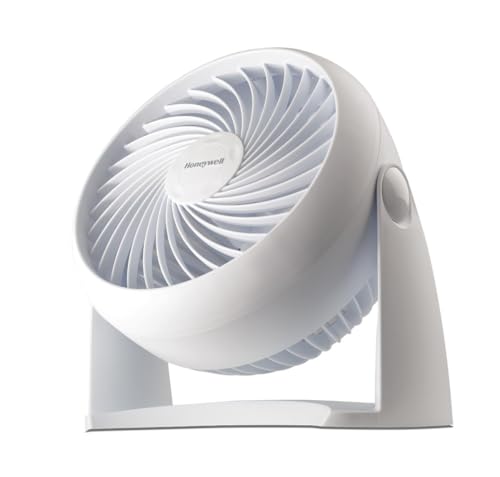
Best for Budget-friendly circulator-style airflow for mid-size rooms
- Adjustable height and pivoting head for aimed airflow
- Turbo Force air compression for a stronger stream than a standard box fan
- Multiple speed settings with a compact, portable base
- Noticeably lower price than premium circulator brands
- Portable, lightweight base that's easy to move room to room
- Adjustable head aims air where it's needed
- Grille spacing and stability are less refined than premium circulators, so keep it away from toddlers and pets
Verdict: A solid budget circulator for anyone who wants stronger directed airflow than a box fan without paying for a premium brand.
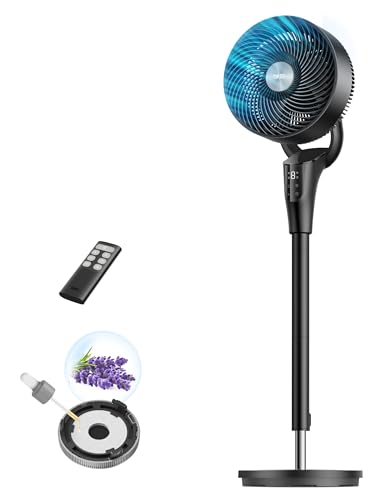
Best for Quiet, app-and-voice-controlled airflow for a bedroom or living room
- DC motor rated for quiet operation at low speeds
- App and voice assistant control alongside a physical remote
- Wide oscillation range with multiple speed and sleep-mode settings
- Quieter low-speed operation than most AC-motor fans
- Smart features fit into an existing smart-home routine
- Wide oscillation spreads airflow across a room
- Smart features add cost over a simple manual fan for buyers who don't want them
Verdict: A good match for anyone who already uses smart-home controls and wants a quiet fan that fits into that ecosystem.

Best for High-velocity airflow in a garage, workshop, or job site
- 3-speed high-velocity motor built for long-distance airflow
- Tilt-back housing to aim air up or across a large space
- Compact, portable design with a carry handle
- Genuinely strong airflow for drying wet floors or venting a garage
- Portable and easy to angle at a work area
- Affordable relative to its airflow output
- Loud on high speed — not a fit for bedrooms or nurseries
- Open blade design means it should stay out of reach of young children and pets
Verdict: Built for utility spaces where raw airflow matters more than quiet operation or blade safety.
Frequently Asked Questions
Do bladeless fans actually use less energy than regular fans?
Not necessarily. Bladeless fans use a small internal impeller and motor just like any other electric fan, and energy use depends on the specific model's wattage and speed setting, not on whether the blade is hidden. Check the manufacturer's wattage spec rather than assuming bladeless automatically means lower power draw.
Can an air circulator cool a room the way an air conditioner does?
No. An air circulator moves and mixes existing air; it doesn't lower the air's actual temperature the way an air conditioner does. It can make a room feel more evenly cool by pushing cooler air from an AC unit or a shaded window into a stuffy corner, and it helps evaporative cooling on skin, but it isn't a substitute for mechanical cooling on a genuinely hot day.
Are bladeless fans harder to clean than regular fans?
Generally the opposite. Because there's no blade or motor cage inside the airflow path, most bladeless fans only need the base grille and outer loop wiped down with a cloth. Standard fans require removing a front grille and wiping down individual blades, which collect more dust over time.
What CFM or throw distance is enough for a typical bedroom versus a garage?
A bedroom or home office generally just needs close-range comfort, so a bladeless or small pedestal fan felt within 6 to 10 feet is enough. A garage, basement, or any larger open space benefits from a circulator rated to throw air 30 feet or more, since the goal is mixing air across the whole room rather than cooling one spot.