Best Box And Window Fans
Best Box And Window Fans, ranked from aggregated owner ratings and reviews, not first-hand testing. Real pros, cons, and who each pick is best for.


Our Top 3 Picks
Quick Comparison
| Product | Best for | Buy | |
|---|---|---|---|
| 20-Inch Weather-Shield Select Box Fan (B20401) | Best Overall | See Amazon | View |
| 9-Inch Twin Window Fan | Best Value | See Amazon | View |
| Twin Reversible Airflow Window Fan (BW2300-N) | Best for Cross-Ventilation | See Amazon | View |
| Dual Blade Twin Window Fan (HAWF2043) | Best for Large Windows | See Amazon | View |
| CZ310R High Velocity Box Fan | Best High-Velocity Pick | See Amazon | View |
How to Choose a Box or Window Fan
Start With the Job, Not the Fan
Box fans and window fans aren't interchangeable, so the first decision is what you're
actually trying to do:
- Move air within a room (spot cooling, circulating a window fan's airflow, drying carpet
- Exchange air between indoors and outdoors (venting a hot house in the evening, pulling
- Both, from one window → a twin or triple window fan with independent reversible blades.
Key Specs Worth Comparing
- CFM (cubic feet per minute). This is the real measure of how much air a fan moves, and
- Number of speeds. Three-speed fans are the sweet spot for most households: high for
- Reversible / independent intake-exhaust switches. Essential for a window fan meant to do
- Window fit range. Check the accordion panel range against your actual window opening,
- Noise (dB, if published). Twin-blade fans running two smaller motors are often quieter
- Weather resistance. A sealed or "weather-shield" housing rating matters for a fan that
- Thermostat or timer controls. A built-in thermostat that cycles the fan on and off
Sizing for the Room
There's no single CFM-per-square-foot rule that holds up across every room shape and ceiling
height, and any number offered as one would be more precise than the underlying physics
allows. As a practical starting point: a single window fan in a bedroom-sized room is usually
adequate for that room alone, while cooling an entire small house through cross-ventilation
works better with a fan (or two) at each end of the air path rather than one fan trying to do
all the work from the middle of the house.
Who Should Skip a Window Fan Entirely
- Casement or crank-style windows that don't open with a horizontal sliding sash often
- Security-conscious ground-floor rooms where leaving a window open overnight (even with a
- Anyone expecting air-conditioner-level cooling. Window and box fans move air; they don't
- Allergy-sensitive households during high-pollen periods — pulling in unfiltered outside
A Note on Energy Use
Both box fans and window fans are inexpensive to run compared to air conditioning — figure a
typical box or window fan draws somewhere in the range of a few dozen to around 100 watts on
its highest setting, versus roughly ten times that (or more) for a small window air
conditioner. ENERGY STAR doesn't currently certify box or window fans the way it does room
air conditioners, so wattage comparisons between models are the more useful shopping metric
than any certification badge.
Full Ranking, Reviewed
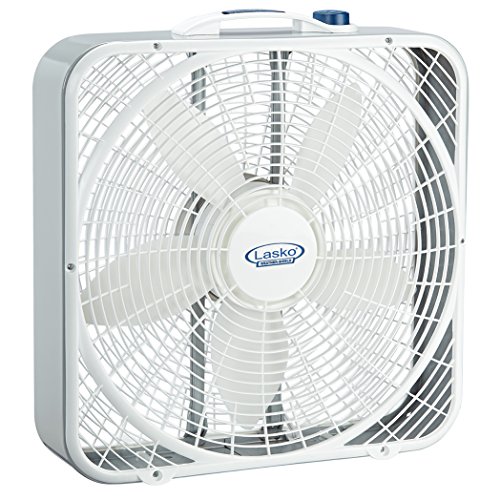
Best for General-purpose room air movement, doorways, and drying damp spaces
- 3 quiet speeds with a top-mounted, easy-to-reach speed selector
- Weather-Shield housing intended for covered porches and semi-exposed spots, not direct rain
- Lightweight molded housing with an integrated top carry handle
- Standard 20-inch box format fits most doorways, closets, and window openings when needed
- Inexpensive and widely available at hardware and home stores
- Simple to operate with no assembly beyond attaching the legs
- Moves a lot of air for the price on its highest speed
- No reversible or independent intake/exhaust control — direction is set by which way you turn the fan
- Motor hum is noticeable on the highest speed in a quiet room
Verdict: The default, no-frills choice for spot cooling and general air movement — buy this one first and add a window fan only if you specifically need indoor/outdoor air exchange.
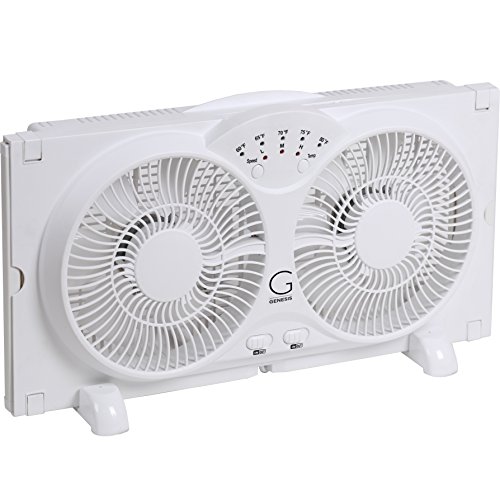
Best for Budget-friendly twin-blade intake/exhaust ventilation in a standard window
- Two independently reversible 9-inch blades in one housing
- 3-speed control per side for separate intake/exhaust speed settings
- Expandable accordion side panels for a range of standard window widths
- Compact, lightweight housing that's easy to install and store off-season
- Independent reversible control on each blade at a lower price point than premium twin fans
- Easy one-person installation in a standard double-hung window
- Small footprint doesn't block much of the window when not centered
- Smaller 9-inch blades move noticeably less air at top speed than larger twin-window models
- Plastic housing feels less rugged than steel-bodied box fans
Verdict: A sensible entry point for cross-ventilating a single window without paying for features like a thermostat you may not use.

Best for Running one blade on intake and the other on exhaust in the same window
- Two independently reversible blades, each with its own intake/exhaust switch
- 3 speeds per blade for fine-tuned day and night settings
- Electronic thermostat control to auto-cycle the fan around a target temperature
- Expandable side panels for a range of standard window widths with a bug- and light-blocking seal
- True independent dual-direction control from a single window opening
- Built-in thermostat is genuinely useful for unattended overnight intake use
- Reasonably quiet on low/medium speeds for overnight operation
- Higher price than a basic single-direction twin fan
- Thermostat sensor placement means it reads the air right at the window, not the center of the room
Verdict: The clearest match for the twin-window use case in this guide — set one blade to pull cool air in while the other pushes warm air out, all from one window.

Best for Wider window openings where a single small twin fan leaves gaps
- Two independently reversible blades with 3-speed control per side
- Extra-wide expandable panels rated for a broader window-width range than compact twin models
- Manual thermostat dial for basic temperature-triggered cycling
- Slim profile designed to sit low in the window track, leaving more of the upper sash usable
- Wider panel range suits larger or older double-hung windows more comfortably
- Independent blade control for the same intake/exhaust flexibility as smaller twin fans
- Low-profile housing leaves more window clearance above the fan
- Bulkier housing takes up more storage space in the off-season
- Thermostat is a basic manual dial rather than a precise digital setpoint
Verdict: Reach for this one specifically when a compact twin window fan's panels don't extend far enough to seal your window opening cleanly.

Best for Maximum room airflow for garages, workshops, and larger open rooms
- High-velocity motor pushing more CFM at top speed than a standard-duty box fan
- 3-speed rotary control
- Steel front and rear grilles for added durability in workshop or garage settings
- Rear carry handle for moving between rooms or job sites
- Strong airflow output relative to size, good for larger or harder-to-cool rooms
- Steel grille construction holds up to rougher handling than fully plastic housings
- Noticeably louder than standard box fans on its top speed
- No reversible or window-sealing features — a pure room air mover, not a window fan substitute
Verdict: Worth the step up from a basic box fan when the room is larger than a bedroom or when you need to clear hot air quickly in a garage or workshop.
Frequently Asked Questions
Should I run a window fan facing in or out at night?
Once outdoor air is cooler than indoor air — typically late evening through early morning in summer — set the window fan to intake so it pulls that cooler air in. Switch back to exhaust (or turn it off) once the outdoor temperature climbs back above the indoor temperature, usually mid-morning.
Can I leave a window fan running in a light rain?
Only if the specific model is rated for weather resistance, and even then, only for light, non-driving rain. Check the manufacturer's manual for the exact guidance for that model — as a general rule, close the window or remove the fan ahead of any storm with wind-blown or heavy rain, since water reaching the motor housing is an electrical hazard, not just a nuisance.
Do twin window fans use noticeably more electricity than a single-blade fan?
Not dramatically — two smaller motors doing the combined work of one larger motor draw a broadly similar total wattage at a given airflow, and running one blade on low while the other runs on high (or is off) uses less than running both on high. Check the wattage listed for each speed on the specific model rather than assuming twin means double the power draw.
Will a box fan in a window work as well as a dedicated window fan?
It will move some air, but a plain box fan isn't shaped to seal a window opening the way a dedicated window fan's accordion panels do, so more air leaks around the edges instead of passing through the fan. It also lacks the reversible intake/exhaust switch. A box fan propped in a window is a reasonable stopgap, not a long-term substitute.