Best Quiet Ceiling Fans
Best Quiet Ceiling Fans, ranked from aggregated owner ratings and reviews, not first-hand testing. Real pros, cons, and who each pick is best for.

Our Top 3 Picks
Quick Comparison
How to Choose a Quiet Ceiling Fan
Quiet ceiling fans aren't a single product category — they're regular ceiling fans that
happen to combine a well-balanced DC motor, precision-molded blades, and solid mounting
hardware. Here's what actually separates a genuinely quiet fan from one that's just
marketed that way.
Start With the Sone Rating, Not the Marketing Copy
Look for a published sone rating at each speed, ideally from the manufacturer's spec sheet
rather than the product listing headline. A fan advertised as "whisper quiet" with no sone
number listed anywhere is a red flag. As a rule of thumb:
- Bedrooms and nurseries: look for under 1 sone at medium speed
- Living rooms and home offices: 1-2 sones at medium-high is comfortable
- Covered patios, garages, and rec rooms: noise tolerance is more flexible, so prioritize
Prioritize DC Motors for Genuinely Quiet Performance
Nearly every fan that tests under 1 sone on the market today uses a DC motor. AC motors can
be quiet at low speed, but they get noticeably louder as you push toward high speed because
they're mechanically less efficient. If quiet operation at real, everyday speeds (not just
"low") is the priority, filter for DC motor fans first and compare sone ratings second.
Check CFM and CFM-per-Watt Together
A fan can be quiet simply because it's underpowered. Don't chase silence at the cost of
airflow — check that CFM at high speed is appropriate for your room size (see the sizing
guidance in the sub-hub guide above), then compare CFM-per-watt across your shortlist to
find the most efficient option that still moves enough air.
Blade Pitch and Material Affect Noise Too
Steeper blade pitch (12-14 degrees) generally moves more air per rotation but can introduce
more wind noise at high speed than a well-designed lower-pitch blade paired with a stronger
motor. Solid wood or molded composite blades that are properly balanced from the factory
tend to run quieter over time than thin stamped-metal blades, which can develop a faint
resonance or rattle as screws loosen with seasonal temperature swings.
Mounting and Installation Quality Matter as Much as the Fan Itself
Even the best-rated fan will hum or wobble if it's:
- Hung from a light-duty electrical box not rated for fan weight and torque
- Mounted too close to the ceiling without proper clearance
- Installed with a downrod that isn't perfectly vertical
- Missing balancing weights on the blade arms
Smart Features Are a Nice-to-Have, Not a Noise Fix
Wi-Fi control, app scheduling, and voice assistant integration (Alexa, Google Home) don't
make a fan quieter — they make it more convenient to run the fan at the right speed for the
room, which indirectly helps, since running a fan at 60% instead of 100% is quieter on
almost any motor. If two fans have identical motors and blades, smart controls are a
reasonable tiebreaker, not a primary decision factor.
Who Should Skip a Premium Quiet Fan
If you're cooling a garage, workshop, covered patio, or any space where background noise
from other equipment already exceeds fan noise, spending extra for a sub-1-sone DC fan
isn't worth it — put that budget toward a larger blade span or weather/damp rating instead.
Similarly, if the room is small (under 100 sq ft) and you'll mostly run the fan on low,
even a mid-range AC fan will be quiet enough in practice.
Full Ranking, Reviewed
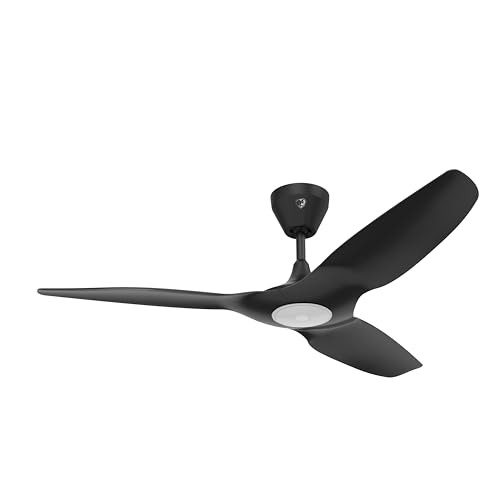
Best for Bedrooms and living rooms where near-silent operation is the top priority
- Sensor-driven DC motor with SenseME app control and Alexa/Google Home support
- Rated among the quietest fans on the market at low-to-medium speeds
- Available in 52-, 60-, and 84-inch blade spans for small to large rooms
- Exceptionally quiet DC motor even at higher speeds
- Sleek, low-profile design that suits modern interiors
- Premium price point compared to most residential ceiling fans
Verdict: The Haiku is the fan to buy when quiet operation is non-negotiable and budget is secondary — it consistently tests as one of the quietest DC fans available.

Best for Homeowners who want full app and voice control alongside quiet DC performance
- All-DC motor lineup built for smart home integration (Wi-Fi, Alexa, Google Home)
- Six-speed control with reverse airflow set from the app, no pull chains
- Integrated LED module available on select models
- Strong app ecosystem with scheduling and multi-fan grouping
- Quiet, well-balanced DC motor across speed settings
- App/Wi-Fi setup adds a learning curve some buyers won't want
Verdict: A great pick for a connected-home setup where you want reliable app and voice control without giving up quiet, efficient airflow.

Best for Great rooms and open-concept living areas needing high CFM without excess noise
- Reversible DC motor with six speeds and remote control included
- Large 52-inch blade span rated for strong high-speed airflow
- Reversible blade finish for two look options on one fan
- High CFM output relative to its DC motor's power draw
- Solid build quality typical of Minka-Aire's fan lineup
- Noticeably more audible at top speed than at medium, so top speed isn't ideal for quiet bedrooms
Verdict: Delivers the airflow a larger room needs while staying quiet at the medium speeds most owners actually use day to day.

Best for Buyers who want DC-motor quiet performance without a premium-brand price tag
- DC motor with six speeds and included remote
- Damp-rated option available for covered patios and sunrooms
- Integrated LED light kit option
- Noticeably quieter and more efficient than comparable AC fans at a similar price
- Damp-rated variant adds flexibility for covered outdoor spaces
- Remote and app features are more basic than premium smart-fan competitors
Verdict: The best entry point into DC-motor quiet performance if you don't need app control or a designer finish.

Best for Formal living rooms and primary bedrooms where finish quality matters as much as quiet operation
- DC motor engineered for quiet operation with six speeds
- Premium finish options including hand-carved-look blades
- Full-function remote with reverse and light dimming
- High-end finish and build quality from a long-established fan brand
- Quiet at low-to-medium speeds, suitable for bedrooms
- Higher price than Fanimation or other mid-range DC options for similar airflow
Verdict: Worth the upgrade if you want a quiet DC fan that also looks like a furniture-grade fixture rather than a utilitarian one.
Frequently Asked Questions
What sone rating counts as "quiet" for a ceiling fan?
Under 1 sone at medium speed is considered whisper-quiet and suitable for bedrooms; 1-2 sones is comfortably quiet for living rooms; 3 sones or higher becomes noticeable over normal conversation, especially at top speed.
Do DC ceiling fans cost more to buy than AC fans?
Generally yes — DC motors add electronics that raise the upfront price, often by $50-150 compared to a similarly sized AC fan. That cost is typically offset over time through lower energy use and, for many owners, longer motor life since DC motors run cooler.
Can a quiet fan still move enough air for a large room?
Yes, as long as you check CFM at high speed rather than assuming quiet means underpowered. Several DC fans in the 60-72 inch blade span range deliver 6,000+ CFM while staying under 2 sones, because the DC motor's efficiency allows strong airflow without the mechanical noise of an equivalent AC motor.
Will a smart ceiling fan app make my fan run quieter?
No — the app controls speed and scheduling, not the underlying motor or blade noise. It can help indirectly by making it easier to run the fan at a lower, quieter speed setting instead of defaulting to high.