

DC, Quiet & Energy-Efficient Ceiling Fans, Explained
If a ceiling fan hums, ticks, or drones loud enough to notice over a TV or a bedside
conversation, the motor is usually the reason. Over the last decade, DC (direct current)
motors have become the standard answer for homeowners who want strong airflow without
the noise or the power bill of an older AC fan. This guide breaks down what "DC," "quiet,"
and "energy-efficient" actually mean on a spec sheet, so you can compare fans by numbers
instead of marketing language.
AC Motors vs. DC Motors
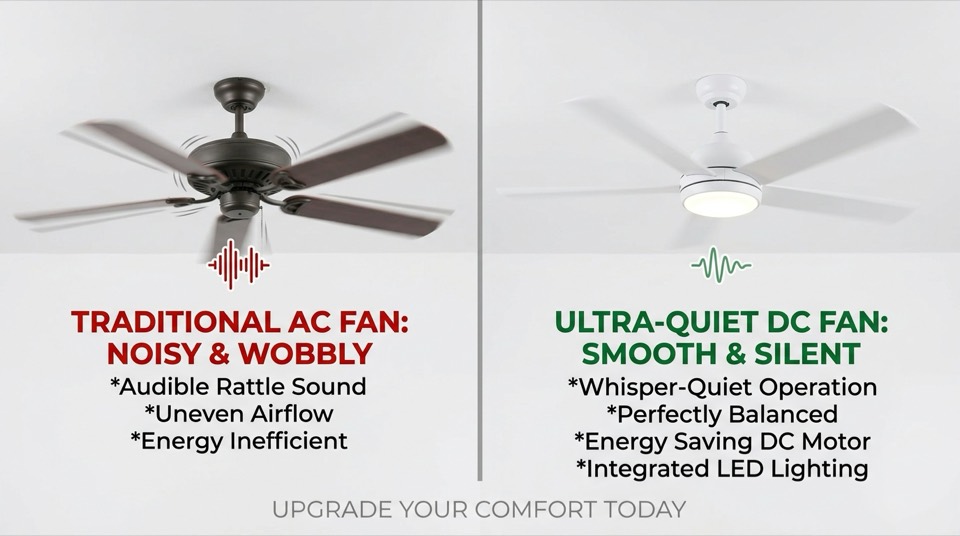
Most ceiling fans built before the mid-2010s use an AC (alternating current) motor: simple,
inexpensive, and reliable, but inherently less efficient. AC motors run at only a few fixed
speeds and waste more energy as heat, which shows up as extra motor noise and a warmer motor
housing over long runtimes.
A DC motor uses an internal circuit board to convert household AC power to DC and drive the
motor magnetically, similar to the motors in laptop fans and electric vehicles. The benefits
that matter for buyers:
- Lower power draw. A typical DC ceiling fan draws roughly 6-25 watts on medium-high
- More speed steps. Six speeds (versus three on most AC fans) means finer control, so
- Quieter operation. Less electrical waste means less motor vibration and hum, which is
The tradeoff is upfront cost: DC fans typically cost more than a comparable AC fan because
of the added electronics.
How to Read Airflow and Efficiency Numbers
Two figures matter more than blade span or finish:
- CFM (cubic feet per minute) measures how much air the fan actually moves on its
- Airflow efficiency (CFM per watt) measures how much air you get per unit of energy.
How to Read Noise Numbers
Noise is measured in sones, a linear loudness scale where 1 sone is roughly the sound
of a quiet refrigerator. Most quality ceiling fans publish a sone rating at each speed:
- Under 1 sone: essentially silent, ideal for bedrooms and nurseries
- 1-2 sones: quiet, noticeable only in a silent room
- 3+ sones: audible over normal conversation, more common on cheaper AC fans at top speed
Smart Controls and DC Fans
Because a DC motor is already driven by a control board, most DC fans pair naturally with
smart features: multi-speed remotes, wall controls, and Wi-Fi/Bluetooth apps that work with
Amazon Alexa or Google Home. Some also support summer/winter reverse from the remote instead
of a manual switch on the housing, which matters for energy efficiency — running a fan
counterclockwise in summer (pushing air straight down) and clockwise in winter on low speed
(gently pulling warm air off the ceiling) is one of the simplest free efficiency upgrades in
a home, per Department of Energy guidance on ceiling fan use.
Sizing and Placement Still Matter More Than Motor Type
A DC motor won't fix a fan that's the wrong size for the room, mounted too close to the
ceiling, or placed off-center. Before comparing individual models:
- Match blade span to room size (roughly 36-42 inches for rooms up to 100 sq ft, up to
- Keep at least 7 feet of clearance from the floor to the blades, and use a downrod in
- For sloped or vaulted ceilings, confirm the fan is rated for a sloped-ceiling adapter
Installation and Electrical Safety
Swapping a fan onto existing wiring, adding a wall control, or replacing an outlet box
rated only for a light fixture (not the added weight and torque of a fan) all touch your
home's electrical system. Always turn off power at the breaker before opening any
electrical box, and confirm the existing outlet box is fan-rated before hanging a fan
from it. If you need a new circuit, a dedicated wall switch leg, or you're not confident
reading the wiring diagram, hire a licensed electrician — improper fan support or
wiring is a fire and fall hazard, and many jurisdictions require a permit for new circuits
or box replacements.
Bottom Line
If quiet operation and lower running cost matter more than upfront price, a DC-motor,
ENERGY STAR-certified fan is worth the premium for most bedrooms, home offices, and
media rooms. For garages, covered patios, and rooms where noise is a non-issue, a
well-built AC fan can still be the practical choice.