Best Ceiling Fans For Small Rooms
Best Ceiling Fans For Small Rooms, ranked from aggregated owner ratings and reviews, not first-hand testing. Real pros, cons, and who each pick is best for.


Our Top 3 Picks
Quick Comparison
| Product | Best for | Buy | |
|---|---|---|---|
| Bling 42-Inch Low Profile Ceiling Fan | Best Overall | See Amazon | View |
| Glen Alden 36-Inch Ceiling Fan | Best Value | See Amazon | View |
| Concept III 44-Inch LED Ceiling Fan | Best Premium | See Amazon | View |
| Sea Wind 44-Inch Damp-Rated Ceiling Fan | Best for Bathrooms | See Amazon | View |
| Haiku L Series Smart Ceiling Fan | Best Smart Pick | See Amazon | View |
How to Choose a Ceiling Fan for a Small Room
Measure Before You Shop
Multiply the room's length and width in feet to get square footage, then match that number to a blade span in the 29-42 inch range depending on how small the room actually is. Resist the urge to size down further just because the room feels tight visually; a fan sized correctly for the floor area, run on a lower speed, is more comfortable than an undersized fan running flat out.
Prioritize Hugger or Low-Profile Mounts on Low Ceilings
If the room has a standard 8-foot ceiling, a flush-mount (hugger) fan is usually the right call so the blades stay well above head height. Check the manufacturer's spec sheet for the exact distance from ceiling to blade, and confirm it leaves at least the 7 feet of floor clearance most codes and manufacturers require. On 9-foot-plus ceilings, a short downrod can still work and may perform slightly better than a hugger of the same blade span.
Check CFM, Not Just Blade Span
Two fans with the same diameter can move very different amounts of air depending on motor strength and blade pitch. ENERGY STAR-certified fans list CFM (cubic feet per minute), which lets you compare airflow directly instead of guessing from size alone. For a small room, a combined CFM in roughly the 1,000-2,000 range across all speeds is generally sufficient.
Match the Room's Function
- Bathroom or laundry room: prioritize a UL damp rating over style; a fan without the right rating can corrode from ambient humidity even if it never gets directly wet.
- Bedroom or home office: prioritize a quiet motor, ideally a DC motor, since you'll be sitting or sleeping close to it.
- Closet or small nook: a compact 29-36 inch fan with a simple pull-chain or wall control is often enough; you don't need smart features or a large light kit in this size room.
Lighting: Keep It Proportional
If you want an integrated light kit, check total lumens and Kelvin color temperature the same way you would for a standalone fixture. A small room rarely needs more than a few hundred to around 1,000 lumens from the fan light if it's supplementing other fixtures in the room; a kit far brighter than that can feel disproportionate to the space. A warm 2700-3000K temperature suits most bedrooms and closets, while a cooler 3500-4000K option works better in a small home office or laundry room.
Control Options
A basic pull-chain or included remote is enough for most small-room fans. Smart, app-connected models exist and can be convenient, but they add cost and setup that a bathroom or closet fan usually doesn't need. Save smart-home features for rooms where you'll actually use scheduling or voice control day to day.
Who Should Skip a Compact Fan
If your "small" room is actually a small great room or an open-plan area over roughly 150-200 square feet, don't force a compact fan into it just because the ceiling looks modest; check the square footage chart again, since you may be better served by a 44-50 inch fan than by undersizing. Likewise, if the room has a vaulted or sloped ceiling, a compact flush-mount fan isn't the right hardware category at all; you'll need a sloped-ceiling adapter kit and likely a downrod, which changes the mounting decision more than the sizing one.
A Safety Reminder
Small rooms still involve the same hardwired electrical work as any other ceiling fan installation. Turn off power at the breaker before working on any fixture, use a fan-rated electrical box, and bring in a licensed electrician for new circuits or wiring you're not fully confident handling yourself.
Full Ranking, Reviewed

Best for Small to medium bedrooms with 8-foot ceilings
- Low-profile flush mount built for standard 8-foot ceilings
- Reversible blades for seasonal airflow direction
- Included remote control for speed adjustment
- Compact 42-inch span fits comfortably in small bedrooms and home offices
- Straightforward install onto an existing fan-rated box
- No integrated light kit, so you'll need a separate fixture if you want overhead lighting
Verdict: A dependable, well-proportioned pick for small bedrooms that don't need a light kit built in.

Best for Closets, laundry rooms, and small nooks on a budget
- Compact 36-inch blade span for tight spaces
- Pull-chain operation with reversible motor
- Low-profile mount for ceilings under 8 feet
- Budget-friendly price point for a small-space fan
- Simple pull-chain control with no remote to lose or pair
- Basic three-speed motor lacks the finer speed control of DC models
Verdict: A no-frills, affordable option that covers the basics for a closet, laundry room, or small nook.
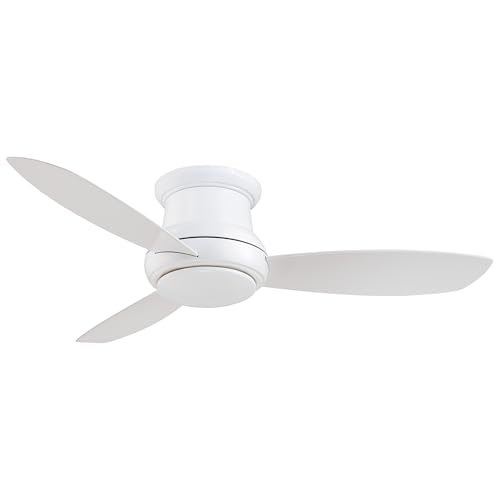
Best for Small bedrooms or home offices wanting a bright, modern light kit
- Slim, low-profile housing with integrated dimmable LED
- DC motor with six speeds for finer airflow control
- Included wall control with dimming and reverse function
- Quiet DC motor suited to bedrooms and home offices
- Dimmable LED light kit bright enough to serve as the room's main light
- Higher price point than basic small-room fans
Verdict: A quiet, modern option worth the premium if you want strong light output and finer speed control in a small room.

Best for Bathrooms and covered damp areas
- UL damp-rated for bathrooms and covered outdoor spaces
- Reversible plastic blades resistant to humidity and moisture
- Standard pull-chain control
- Damp rating means it's built to handle bathroom humidity long-term
- Weather-resistant blades won't warp the way some wood-look blades can in moisture
- Not wet-rated, so it isn't suitable for a spot exposed to direct rain or spray
Verdict: A solid, purpose-built choice for a small bathroom where a standard indoor fan would eventually corrode.

Best for Small bedrooms or offices wanting app and voice control
- Compact-friendly sizing with a whisper-quiet DC motor
- App-based control with scheduling and voice assistant compatibility
- SenseME technology that adjusts speed based on room temperature
- Very quiet motor, well suited to bedrooms and focused workspaces
- App scheduling is genuinely convenient once set up
- Significantly more expensive than a basic pull-chain small-room fan
Verdict: The right pick if you specifically want smart scheduling and voice control in a compact room and don't mind the added cost.


Frequently Asked Questions
Is a smaller ceiling fan always better for a small room?
No. A fan sized too small for the room's square footage has to spin faster to move the same amount of air, which often makes it noisier and less effective, not more proportional. Match the blade span to the square footage chart rather than choosing the smallest fan available.
Can I use a hugger fan in any small room?
Hugger, or flush-mount, fans work well on ceilings around 8 feet or lower, which is common in many small rooms. On 9-foot-plus ceilings, a short downrod-mounted fan of the same blade span will generally move slightly more air, so a hugger isn't strictly required just because the room is small.
What size fan is right for a small bathroom?
Most small bathrooms fall under 50 square feet and suit a 29-36 inch fan. Just as important as size is the UL rating: choose a damp-rated fan built to handle bathroom humidity, since a standard indoor fan can corrode over time in that environment.
Do small-room ceiling fans need a special electrical box?
Yes, the same fan-rated electrical box required for any ceiling fan. Fans are heavier and vibrate more than standard light fixtures, and room size doesn't change that requirement. If you're unsure whether an existing box is fan-rated, have a licensed electrician check it.