

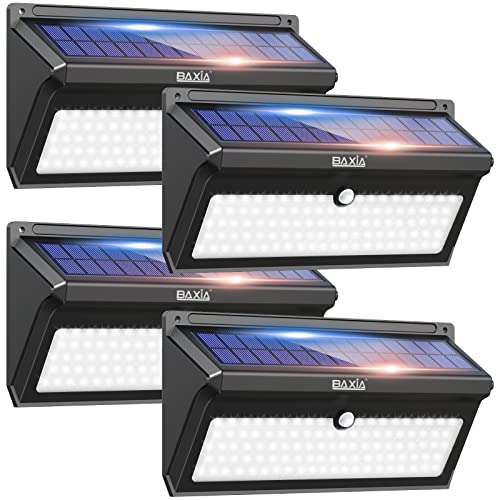



PIR (passive infrared) motion sensor lights detect the heat a moving body gives off, while microwave sensors send out radio waves and measure how they bounce back. PIR is cheaper, more common, and less prone to false alarms. Microwave sensors sense through thin materials and cover a wider area, but they can be over-sensitive.
How PIR sensors work
A passive infrared sensor is "passive" because it emits nothing. It simply watches the infrared (heat) energy in its field of view. When a warm object such as a person or animal moves across the zones the lens divides the view into, the sensor sees a rapid change in heat and triggers the light.
Key traits of PIR:
- Detects heat in motion, so it responds well to people and animals.
- Needs a mostly clear line of sight; it cannot see through walls or solid objects.
- Works in defined detection zones and is best at catching movement that crosses the view.
- Uses very little power, which suits battery models.
How microwave sensors work
A microwave sensor is "active." It continuously emits low-power microwave (radio) pulses and listens for the echo. When something moves, the returning signal shifts in frequency (the Doppler effect), and the sensor reacts.
Key traits of microwave:
- Detects any movement, warm or not, based on changes in the reflected signal.
- Can sense through thin, non-metal materials such as glass, plastic, or a hollow door.
- Offers a larger, more sensitive coverage area.
- Reacts quickly and can detect motion coming straight toward it, not just crossing.
Side-by-side comparison
- Trigger method: PIR reads body heat; microwave reads reflected radio waves.
- Cost: PIR is generally cheaper; microwave units cost more.
- Coverage: microwave typically covers a wider area and reacts more sensitively.
- False alarms: PIR is less twitchy outdoors; microwave can trigger on motion beyond the intended zone, including through a wall.
- Sees through materials: microwave can, within limits; PIR cannot.
- Weather and temperature: PIR range shrinks on hot days because the contrast between body heat and background falls; microwave is less affected by temperature.
- Power use: PIR sips power; microwave draws more because it transmits constantly.
Strengths and weaknesses in real use
PIR shines in typical outdoor security lighting: porches, driveways, garages, and yards. It rarely fires without a genuine warm mover, which keeps nuisance triggers down. Its weaknesses are hot-weather range loss, blind spots behind objects, and a preference for crossing motion over head-on approach.
Microwave shines where you need broad, reliable coverage or where the sensor must sit behind a cover, such as inside a diffuser or above a ceiling tile. It is popular in commercial spaces, stairwells, and parking structures. Its weakness is over-detection: because radio waves pass through thin walls, a microwave light can trigger on people or cars outside the room you meant to cover, unless its sensitivity and range are dialed back.
Why some lights use both
Higher-end sensors sometimes combine PIR and microwave in a dual-technology design. The light only turns on when both sensors agree that something moved. This sharply reduces false triggers, because a swaying branch might fool one sensor but rarely both at once. Dual-tech units cost more and are more common in commercial and premium security fixtures than in basic residential floods.
Which should you choose
Choose PIR if:
- You want an affordable, dependable outdoor security or porch light.
- False triggers from the street or wildlife are a concern.
- The fixture runs on batteries or you care about energy use.
- You have a clear line of sight to the area you want covered.
- You need to cover a large or oddly shaped area.
- The sensor must be hidden behind a non-metal cover or diffuser.
- You want detection of head-on approach and very small movements.
- You can spend time tuning sensitivity to avoid over-detection.
Placement and tuning tips
- Keep PIR sensors away from heat sources such as vents, grills, and sun-baked metal, which can cause false triggers.
- Aim any sensor so people cross its field of view where possible, and turn a microwave unit's sensitivity down if it reaches past your property line.
- Mounting height matters. Most residential sensors are designed for roughly 6 to 10 feet; too high reduces sensitivity, too low narrows coverage. Check the fixture's guidance.
Safety note
Whether your fixture uses PIR or microwave detection, treat the wiring the same. For any hardwired security light, turn off power at the breaker before installing or opening the housing, and confirm it is off. Hire a licensed electrician for new circuits, junction-box connections, or anything you are unsure about. This article is general information, not a substitute for professional electrical advice.


