


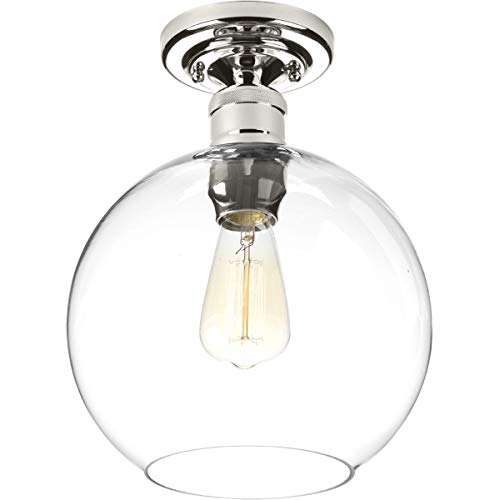
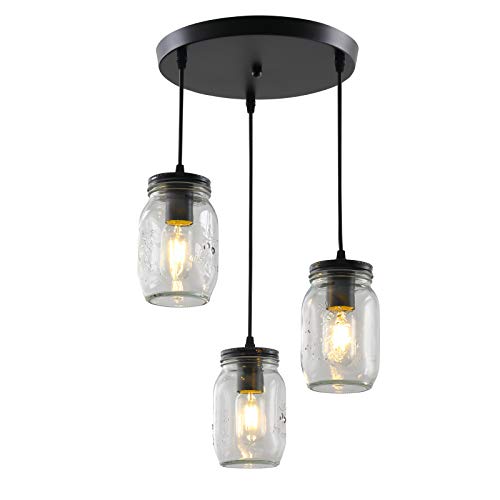


A mini pendant is a small hanging fixture, usually under about 9 inches wide, meant for tight spots or grouping in multiples. A full-size pendant is larger and brighter, meant to anchor a space on its own. Mini pendants suit clusters and accents; full-size pendants suit standalone statements and larger areas.
What counts as a mini pendant?
There's no strict cutoff, but the lighting industry generally treats pendants under roughly 9 inches in diameter as "mini." Full-size pendants run larger, and the biggest ones overlap the territory of small chandeliers. Size is the headline difference, but it drives several practical differences that matter when you're choosing.
Side by side: the key differences
Size and visual weight
- Mini: compact and visually light, easy to use in a row or cluster without dominating a room.
- Full-size: a focal point on its own; one well-placed fixture can carry a whole zone.
Light output and coverage
- Mini: typically fewer or smaller bulbs, so each unit lights a smaller area - great for focused task light or accent glow.
- Full-size: more or larger bulbs and a wider spread, better for lighting a whole table, island, or seating area.
How they're used
- Mini: best in multiples over an island or counter, or singly over a small spot like a nightstand, sink, or breakfast nook.
- Full-size: usually used alone, or as a deliberate pair over larger surfaces.
Where each one shines
Choose mini pendants when
- You want a row of lights over a kitchen island or peninsula.
- The spot is small - a bar corner, a reading nook, a bathroom vanity, or beside a bed as hanging bedside lights.
- You want flexible, layered light rather than one bright source.
- Ceilings are lower and a big fixture would feel heavy.
Choose a full-size pendant when
- You need one fixture to define a space - over a round table, a game table, or an entry.
- You want a statement piece with real presence.
- The room is large or the ceiling is high enough to carry the scale.
- You'd rather hang and wire one fixture than several.
Number of fixtures and spacing
This is where the two paths really diverge.
- Mini pendants are usually planned as a group. Over an island you might use two or three, spaced evenly and centered on the surface, so the effect comes from the arrangement.
- Full-size pendants are usually planned as one, or as a deliberate pair with generous space between them. Crowding large pendants makes a room feel busy.
Scale and proportion tips
Getting the scale right matters more than the label.
- Over an island, the combined width of a row of minis, or the width of a single large pendant, should leave clear breathing room at each end of the counter.
- In a room, a full-size pendant shouldn't be so large it crowds walkways, or so small it looks lost under a high ceiling.
- Hang task pendants, mini or full, so the bottom clears sightlines - over a work counter, roughly 30 to 36 inches above the surface is a common target.
Light quality applies to both
Regardless of size, the same fundamentals decide whether the light is pleasant:
- Color temperature: warm white (2700K-3000K) for living and dining, cooler (up to around 4000K) for task-heavy kitchens; keep sources consistent.
- CRI: 90 or above renders colors more truly.
- Shade style: open or clear shades push more light down for tasks; opaque shades give softer, ambient light.
- Dimming: a dimmer adds flexibility to either type.
Cost and installation notes
- Fixture cost: a single full-size pendant can cost more than one mini, but a group of minis can add up to more overall.
- Installation: each pendant needs a supporting point. Multiple minis mean multiple boxes or a multi-port canopy, while a single full-size pendant is one connection but may be heavier, so the box must be rated for its weight.
Quick decision guide
- Small spot, or you want a row of lights: mini pendant(s).
- One fixture to anchor a bigger space: full-size pendant.
- Layered, flexible light: minis.
- A single statement: full-size.


