


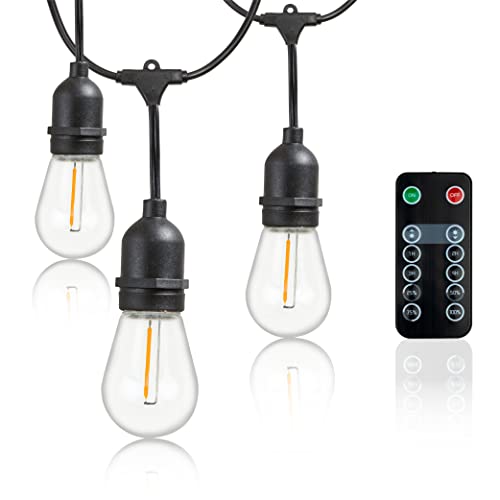



How many string light sets you can safely connect end to end depends on each set's wattage and the circuit, but the golden rule is the maximum number of connected strands printed on the packaging. For LED string lights that number is high, often dozens of sets; incandescent strands may allow only a few before you risk overheating.
Follow the max-connect rating first
Every UL-listed string light set lists a maximum number of sets you can safely connect end to end. This figure is on the box, the tag near the plug, or in the instructions. It already accounts for the wire gauge and the fuse in the plug, so it is the single most important limit to respect.
- If the tag says "connect up to 3 sets," stop at 3, even if a fourth physically plugs in.
- Exceeding the rating can overheat the thin wire and melt insulation at the connections.
Why the limit exists
String lights use light-gauge wire and a small fuse in the male plug. Every set you daisy-chain adds its current draw to the same wire feeding the first plug. The wire nearest the outlet carries the load of every bulb downstream. Push too much current through that thin wire and it heats up, which is a fire risk and why the plug fuses are there to blow.
The fuse protects the strand, but you should never rely on a blown fuse as your plan. Staying within the printed max-connect number keeps the wire comfortably within its safe capacity.
LED versus incandescent: a huge difference
The type of bulb changes everything.
- Incandescent string lights draw a lot of power per bulb, so a typical strand might allow only about 3 to 5 sets connected together.
- LED string lights draw a tiny fraction of that, so many LED strands allow dozens of sets end to end. Some commercial-grade LED lines advertise very long total runs.
Never connect incandescent and LED strands into the same chain, and never mix strands with different plug types or voltages.
The wattage math (if there's no max-connect number)
If a product only lists watts, you can estimate a safe count against the circuit.
For example, if each set draws 20 watts and you have the full 1,440-watt allowance free, that is up to about 70 sets by circuit capacity. But the strand's own max-connect rating almost always sets a lower limit first, so always defer to the smaller number.
Don't forget the whole circuit
The connected-sets rule protects the strand. You also have to protect the branch circuit in your house.
- Add up everything on the same outdoor or garage circuit, not just the lights.
- Outdoor receptacles must be GFCI-protected; the GFCI guards against shock, not overload, so both still matter.
- If breakers trip or plugs feel warm, you are asking too much of the circuit. Reduce the load or split it across circuits.
Safer ways to add more light
When you need more than one chain allows:
- Start a new run from a different outlet on a different circuit.
- Use outdoor-rated extension cords to reach additional outlets rather than over-chaining strands.
- Choose LED strands to fit far more light on each run.
- Consider a timer or smart plug rated for the total load to manage everything at once.
Safety note
Only use lights and cords rated for the location (outdoor lights outdoors), keep connections off wet ground, and add a drip loop at each plug. If you need a new outdoor circuit or receptacle, hire a licensed electrician; exterior outlets must be GFCI-protected in a weatherproof, in-use cover, and any hardwiring should be done with the power off at the breaker and verified dead. This article is general information, not a substitute for a licensed electrician.
Quick answer recap
- Obey the maximum connected sets printed on the packaging above all else.
- Incandescent = only a few sets; LED = many more, often dozens.
- Never mix bulb types, voltages, or plug styles in one chain.
- When you hit the limit, add a new run from another circuit rather than forcing more strands together.


