

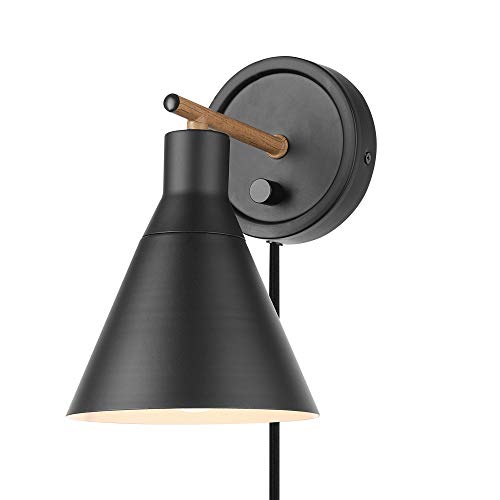



Hang most wall sconces so the center of the fixture sits 60 to 66 inches above the finished floor, near standing eye level. Bathroom sconces beside a mirror land around 60 to 65 inches, hallway and stairway lights sit higher, and bedside sconces drop to about 50 to 60 inches for reading.
Start with the standard height
Sixty to sixty-six inches to the center of the fixture is the reliable default for wall sconces on an open wall. That range keeps the light near the eye level of an average standing adult, so bare bulbs stay out of your sightline and the glow washes evenly across the wall. Treat it as a baseline and adjust for ceiling height, fixture style, and the height of the people using the room.
Three factors shift the number before you commit:
- Ceiling height. Standard 8-foot ceilings suit the 60 to 66 inch range. With 9- or 10-foot ceilings, raise sconces a few inches so proportions stay balanced against taller walls.
- Fixture direction. Uplights, downlights, and shaded sconces send light differently. An open-top uplight mounted too high loses its wall-wash effect; a downlight mounted too low can glare.
- Who lives there. If the household is notably tall or short, move the whole scheme up or down a couple of inches to match actual eye level.
Living rooms and hallways
On a long living-room wall or in an entry, aim for that 60 to 66 inch center height and space multiple sconces evenly, commonly 6 to 8 feet apart, so pools of light overlap gently. Sconces flanking a fireplace, artwork, or a mirror should sit symmetrically on each side, with the fixture center aligned to the middle of the feature when possible.
Hallways follow the same height rule but reward even spacing more than anything. Place a sconce every 8 to 10 feet along the corridor, and center one over any focal point such as a console table. If a hallway is narrow, choose a shallow ADA-style sconce that projects less than 4 inches from the wall so it does not obstruct the walkway.
Bathrooms and vanities
Beside a bathroom mirror, mount sconces at roughly 60 to 65 inches to center, positioned on either side of the mirror rather than above it. Side-mounted sconces light the face evenly and reduce the shadows under the eyes and chin that a single overhead fixture casts. If the mirror is wide or you prefer a single fixture, a light bar above the mirror typically sits about 75 to 80 inches from the floor, just above head height.
Any sconce near a tub or shower must carry the correct rating: damp for humid zones, wet where it may be splashed, and clearances around the shower are governed by electrical code.
Bedrooms and reading nooks
Bedside sconces are the main exception to the eye-level rule because you use them sitting or lying down. Mount them so the bottom of the shade lands around 50 to 60 inches from the floor, or roughly 20 to 24 inches above the mattress top. Test it by sitting in bed: the light should fall on your book or lap without shining in your eyes. Swing-arm styles let each person aim the light independently.
Stairways and outdoor entries
On a staircase, keep sconces at a consistent height measured from each tread's nosing, not from a single floor line, so the fixtures step up with the stairs. About 60 inches above the stair nosing keeps the run visually even. Outdoors, flanking a front door, mount sconces so the center sits around 66 to 72 inches from the porch floor, or use one larger sconce on the handle side at that height.
How to measure and mark
Electrical safety
Most wall sconces are hardwired to a junction box. Before you touch any wiring, turn off power at the breaker and confirm the circuit is dead with a voltage tester. Adding a new box, running a new circuit, or anything you are unsure about is work for a licensed electrician. This site offers general guidance only and is not a substitute for a licensed electrician or your local electrical code.


