

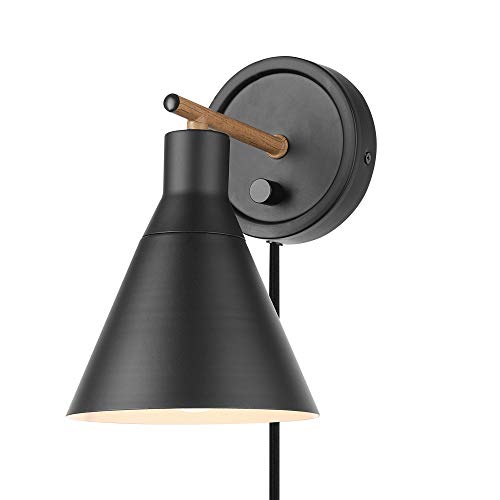



Hardwired wall sconces connect directly to your home's wiring for a clean, permanent look with no visible cord, but they require a junction box and usually an electrician. Plug-in sconces hang anywhere near an outlet, install in minutes with no wiring, and show a cord, making them the flexible, renter-friendly choice.
What sets them apart
The core difference is the power source. A hardwired sconce draws from a junction box in the wall and is controlled by a wall switch, so nothing shows but the fixture. A plug-in sconce ends in a cord and plug that reaches a standard outlet, and it is usually switched at the cord, the outlet, or a smart plug.
That single distinction ripples into installation effort, appearance, cost, and how easily you can change your mind later.
Hardwired sconces
Strengths
- Clean, finished appearance with no visible cord.
- Controlled by an existing or added wall switch, and easy to put on a dimmer.
- Permanently mounted, so the fixture feels built in and adds to the room.
- No outlet needed at the mounting location.
- Requires a junction box; adding one means opening the wall.
- Best installed by a licensed electrician unless a box already exists and you are experienced.
- Harder to relocate, since moving it means patching and rewiring.
- Higher upfront cost once labor is included.
Plug-in sconces
Strengths
- No electrical work; mount the bracket, hang the fixture, and plug it in.
- Ideal for renters and anyone who cannot alter wiring.
- Easy to move, swap, or take with you.
- Lowest upfront cost and fully DIY.
- A cord runs from the fixture to the outlet and is visible unless concealed.
- Placement is limited by outlet locations.
- Switching depends on the cord switch, outlet, or a smart plug rather than a wall switch.
- Can read as less permanent or built-in.
Can you convert one to the other?
Yes, in both directions, with some effort:
- Plug-in to hardwired. If a junction box exists, many plug-in sconces can be hardwired by removing the cord and connecting the fixture wires, work best handed to an electrician.
- Hardwired to plug-in. A hardwired fixture can be fitted with a cord-and-plug kit so it runs off an outlet, useful when you cannot access a box.
Hiding a plug-in cord
If you like the plug-in route but not the cord, you can:
- Run the cord inside a paintable surface-mount channel that blends with the wall.
- Route it behind furniture or a curtain.
- Use a cord cover kit matched to your wall color.
Which should you choose?
Choose hardwired if you own the home, want a permanent and cord-free result, plan to use a wall switch or dimmer, and are comfortable budgeting for an electrician. Choose plug-in if you rent, want a fast DIY install, need to move the light later, or simply have no junction box where you want the sconce.
Match the fixture's rating to the location too, damp or wet ratings for bathrooms and covered exteriors, regardless of how it is powered.
Switching and smart control
Both types can be made smart. A hardwired sconce pairs naturally with a smart wall switch or an in-wall dimmer for scheduling, dimming, and voice control, with nothing extra on show. A plug-in sconce reaches the same scheduling and app control through a simple smart plug, no wiring required. Either way, if dimming matters to you, confirm the fixture and its bulbs are dimmable before buying, because not every LED sconce dims smoothly and some flicker or buzz on the wrong dimmer.
Electrical safety
Any hardwiring means working with your home's circuits. Turn off power at the breaker and verify the wires are dead with a voltage tester before starting. Installing a new junction box, running a new circuit, or converting a fixture is a job for a licensed electrician if you have any doubt. This article is general information, not a replacement for a licensed electrician or your local code.


