
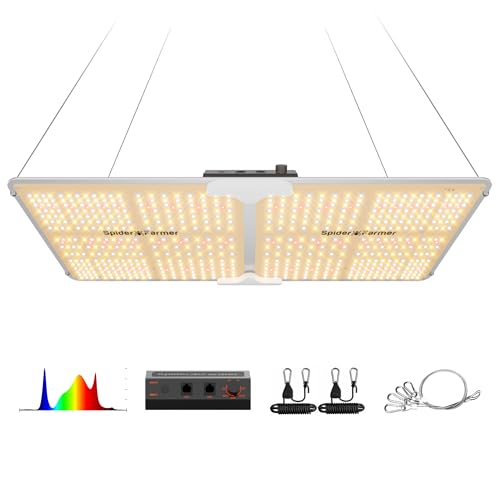


Full spectrum grow lights emit white light across the whole visible range and look natural to your eye, while red-blue ("blurple") lights emit only the specific red and blue wavelengths plants use most. Red-blue can be efficient for pure growth, but full spectrum is more versatile and far easier to work under.
What Plants Actually Use
Plants drive photosynthesis mainly with red (around 660 nm) and blue (around 450 nm) light, which is why early LED grow lights combined just those two colors. But that is not the whole picture. Plants also respond to green, far-red, and other wavelengths that influence leaf shape, stem stretch, flowering, and overall vigor.
The measure that matters most is PAR (photosynthetically active radiation), the band of light roughly 400 to 700 nm that plants use. What counts is how much usable light reaches the plant, not just which colors are present.
Red-Blue ("Blurple") Lights
Red-blue lights use only red and blue diodes, producing the familiar purple-pink glow.
Strengths
- Historically efficient, since every watt goes into the wavelengths plants use most.
- Often lower cost for the output.
- Fine for vegetative growth and basic setups.
- The purple light makes it very hard to inspect plants; you cannot easily spot yellowing, pests, or disease.
- Missing green and far-red can limit results for some plants and growth stages.
- Uncomfortable to work under and unflattering in a living space.
Full Spectrum Lights
Full spectrum lights emit a broad, balanced range that appears white, mimicking natural daylight. Modern white LED grow lights have largely closed the efficiency gap with red-blue.
Strengths
- Covers the wavelengths plants use across all growth stages, from seedling to flower.
- White light lets you see true plant colors, so problems are easy to catch.
- Comfortable for indoor spaces and mixed-use rooms.
- Versatile; one fixture can handle both vegetative and flowering phases.
- Historically slightly less efficient than pure red-blue, though the difference has narrowed.
- Quality varies widely between products, so the spectrum chart matters.
Which Should You Choose?
For most home growers, herbs, houseplants, seedlings, and small indoor gardens, full spectrum is the better all-around choice. It is easier to live with, easier to diagnose problems under, and it handles every growth stage.
Red-blue still makes sense if:
- You want maximum efficiency for a dedicated, out-of-sight grow area.
- Budget is tight and you are lighting a single growth stage.
- You are supplementing an existing setup with extra red or blue.
Reading the Spec Sheet
When comparing grow lights, look past marketing terms and check the real numbers:
- PPF (photosynthetic photon flux): total usable light output, measured in micromoles per second. Higher means more light produced.
- PPFD (photosynthetic photon flux density): the usable light actually reaching the plant at a given distance, in micromoles per square meter per second. This is the practical number for coverage.
- Efficacy (micromoles per joule): how efficiently the fixture turns electricity into usable light. Higher is better.
- Spectrum chart: shows which wavelengths the light emits. Look for coverage across blue, green, and red, ideally with some far-red.
Color Temperature in White Grow Lights
Full spectrum white LEDs are often sold by color temperature:
- Cooler (5000K to 6500K): more blue, favors compact, leafy vegetative growth.
- Warmer (2700K to 3500K): more red, favors flowering and fruiting.
- Broad or tunable: shifts to suit the stage.
Bottom Line
Plants use red and blue most heavily, so red-blue lights are not wrong, just narrow. Full spectrum covers the same critical wavelengths plus the rest, and its white light makes indoor growing far more practical. Unless you have a specific efficiency-driven, hidden-away setup, full spectrum is the more flexible and forgiving choice for home growers, and the easier one to keep healthy plants under day to day.


