


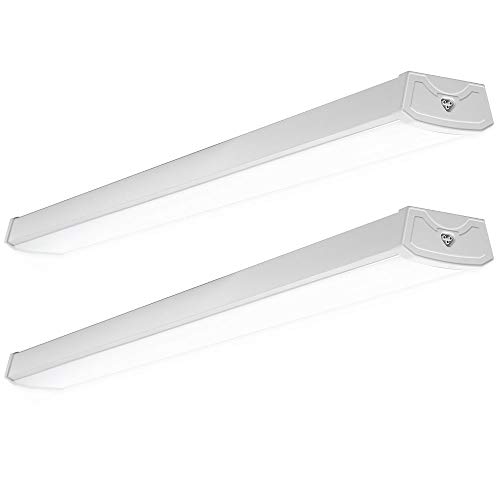


A general-purpose garage needs about 50 lumens per square foot, so a typical two-car garage of roughly 400 square feet wants around 20,000 lumens total. Detailed workshop tasks call for 75 to 100 lumens per square foot, meaning either more fixtures or brighter ones, especially over benches.
The Quick Math
Lighting a garage comes down to two numbers: the area you are lighting and the light level (in lumens per square foot) the space needs.
The formula is simple:
Total lumens = area in square feet x target lumens per square foot
Recommended targets:
- General garage, parking, or storage: 40 to 50 lumens per square foot.
- General workshop: 60 to 75 lumens per square foot.
- Detailed benchwork (fine assembly, finishing, mechanical): 75 to 100+ lumens per square foot.
Worked Examples
One-car garage (about 240 sq ft)
- General use: 240 x 50 = 12,000 lumens.
- Workshop use: 240 x 75 = 18,000 lumens.
- General use: 400 x 50 = 20,000 lumens.
- Workshop use: 400 x 75 = 30,000 lumens.
- General use: 620 x 50 = 31,000 lumens.
- Workshop use: 620 x 75 = 46,500 lumens.
Lumens vs Watts
Do not shop by watts. Watts measure energy use, not brightness. Modern LED shop lights produce far more light per watt than old fluorescent tubes or incandescent bulbs. Always compare the lumen rating on the box, and use watts only to estimate running cost.
Ceiling Height Changes the Answer
Light spreads out and weakens with distance, so a higher ceiling means less light reaching the floor and workbench.
- 8 to 9 ft ceilings: the standard targets above work well.
- 10 to 12 ft ceilings: add roughly 20 to 30 percent more total lumens, or choose fixtures with a tighter beam that direct light downward.
- Very high ceilings: high-bay fixtures are designed for this; they concentrate output so it reaches the floor.
Color Temperature and CRI
Brightness is only half the story. The quality of the light matters too.
- Color temperature: 4000K to 5000K is the sweet spot for garages and shops. It reads as clean, neutral-to-cool daylight that keeps you alert and shows detail well. 5000K is popular for detailed work; 4000K feels slightly warmer.
- CRI (color rendering index): aim for 80 or higher, and 90+ if you do painting, staining, or color-matching, so colors look true.
Fixture Layout Matters as Much as Total Lumens
Hitting your total lumen number does no good if the light is bunched in one spot. Spread fixtures evenly for uniform coverage and fewer shadows.
Tips:
- Run rows of linear shop lights parallel to the main workspace, evenly spaced.
- Position a fixture directly over each major work zone: the bench, the vehicle bays, and any fixed machinery.
- Light-colored walls and ceilings reflect light and effectively boost brightness; a fresh coat of white paint can make a real difference.
- Add dedicated task lighting over benches for close work rather than relying only on overhead fixtures.
A Simple Planning Checklist
Following those steps, a two-car workshop lands around 30,000 lumens spread across six or more evenly placed fixtures, with extra light at the bench.
A Note on Power
Many shop lights simply plug into existing outlets, which is straightforward. If you plan to add new circuits, hardwire fixtures, or install new outlets to support the load, turn off power at the breaker first and hire a licensed electrician for the wiring. Overloading a circuit is a real fire risk, so match your fixtures to the circuit's capacity. This is general information, not a substitute for a licensed electrician.


