


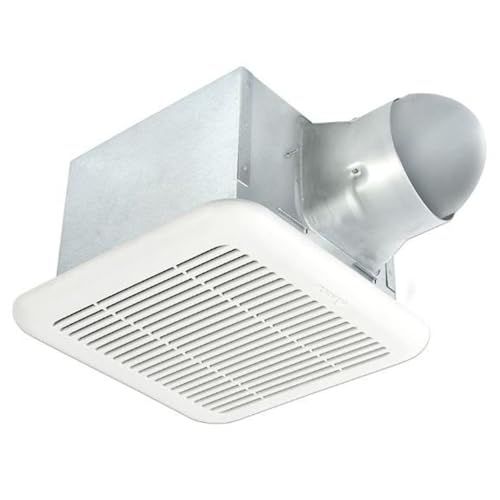

The short answer: 4-inch usually wins
For most bathroom exhaust fans, a 4-inch duct is the safer, better-performing choice. It moves the same airflow with less resistance, keeps the fan quieter, and matches the outlet collar on the majority of modern fans. A 3-inch duct only makes sense for small, low-CFM fans on very short, straight runs.
Why duct diameter matters so much
A bathroom fan is rated in CFM (cubic feet per minute), but that rating is measured against a specific amount of resistance called static pressure. The narrower the duct, the harder the fan has to push, and the more the real-world airflow drops below the number on the box.
Airflow through a round duct depends on the cross-sectional area, not the diameter, and that difference is bigger than it looks:
- A 3-inch round duct has roughly 7 square inches of open area.
- A 4-inch round duct has roughly 12.5 square inches of open area.
What a 3-inch duct actually costs you
When a fan built for a 4-inch outlet is squeezed down to 3-inch pipe, several things happen:
- Airflow drops. The fan spins the same speed but delivers noticeably fewer CFM to the outdoors.
- Noise climbs. Restricted air moving faster through a smaller pipe creates more turbulence and whistle.
- Moisture lingers. Weaker airflow means the room clears steam and humidity more slowly, which is the whole point of the fan.
- The motor works harder. Higher back-pressure can shorten the life of an inexpensive motor.
When a 3-inch duct is acceptable
There are legitimate cases for 3-inch duct:
- The fan's outlet collar is genuinely 3 inches (some compact and older units are).
- The run is short and nearly straight, ideally under about 6 to 8 feet with one gentle elbow.
- The fan is a low-CFM model, roughly 50 CFM or below.
The reducer trap
The most common mistake is buying a fan with a 4-inch collar, then attaching a 3-inch duct with a reducer to reuse an existing hole or pipe. This throttles the fan at its outlet, the worst possible place to add restriction. You lose airflow immediately and gain noise.
If your fan has a 4-inch collar, run 4-inch duct the whole way. Do not step down. Some larger fans instead call for stepping up to 6-inch, so follow the manufacturer's instructions rather than reusing whatever pipe is already in the ceiling.
Run length, elbows, and duct material
Diameter is only part of the picture. Every elbow and every foot of flexible duct adds equivalent length and resistance. A few guidelines that hold up well:
- Keep it short and straight. Fewer turns means better airflow.
- Use smooth-wall rigid metal duct where you can. It has far less friction than flexible foil duct and resists sagging.
- Avoid long flex runs. Flexible duct that dips, kinks, or coils traps condensation and chokes airflow.
- Slope the duct slightly toward the exterior termination so condensation drains outside, not back into the fan.
- Insulate duct in cold attics to reduce condensation forming inside the pipe.
Matching duct size to CFM
As a practical planning rule, think of duct size as a ceiling on how much air you can move quietly:
- 3-inch: small fans up to roughly 50 CFM, short runs only.
- 4-inch: the standard for most 50 to 110 CFM bathroom fans.
- 6-inch: high-CFM fans and long runs, per the manufacturer's spec.
Terminating outside, never into the attic
Whatever diameter you choose, the duct must carry moist air all the way outside through a wall cap or roof cap, not dump it into the attic or soffit. Venting into an attic invites mold, rot, and insulation damage. Use a termination cap with a backdraft damper sized to match your duct.
A note on safety
Bathroom fans are usually hardwired to a circuit, and many installs involve working in an attic or ceiling. Before touching any wiring, turn off power at the breaker and confirm it is off. If you are running a new circuit, tying into existing wiring, or unsure at any point, hire a licensed electrician. This article is general information, not a substitute for a licensed electrician or your local code, which always takes precedence.
Bottom line
Unless you have a small fan with a true 3-inch collar on a short, straight run, choose 4-inch duct. It gives you quieter operation, faster moisture removal, and room to upgrade the fan later without re-running pipe.

