



The short answer
Generally, no. Two bathroom fans should not simply share one duct and one roof vent. Tie two fans into a common pipe and, when only one runs, its air can backdraft down into the other bathroom, carrying moisture and odor with it. The safe defaults are separate ducts to separate caps, or a properly engineered shared system.
Why sharing one duct is a problem
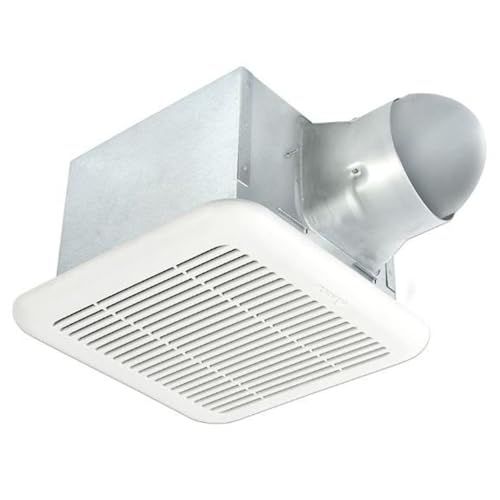
Each exhaust fan is designed to push air against a certain resistance and out through its own termination. When two fans join a single duct, several things go wrong:
- Backdrafting. If one fan runs and the other is off, some of the moving air takes the path of least resistance and flows backward through the idle fan into that bathroom. You get warm, humid, sometimes smelly air pushed into a room you were trying to keep dry.
- Combined static pressure. Both fans now share one pipe, so total airflow resistance rises. Each fan may deliver less than its rating.
- Undersized common duct. Two 4-inch fans feeding a single 4-inch pipe overload it. The shared section has to be larger to carry the combined volume.
- Moisture crossover. Humidity from one bathroom can migrate into the other, defeating the purpose.
What makes a shared system work, if you must
Sometimes attic geometry or a finished roof makes two separate penetrations impractical. A shared exhaust can be done, but it has to be designed rather than improvised:
- Backdraft dampers on every branch. Each fan needs a spring- or gravity-operated damper close to the fan so air cannot flow back into an idle bathroom. Many fans include a built-in damper, but a dedicated inline damper on each branch is more reliable.
- A properly sized common duct. The shared trunk must be large enough to carry both fans running at once, typically stepping up in diameter where the two branches merge. Follow the airflow math, not guesswork.
- A wye, not a tee. Branches should join with a gradual wye fitting so airflow merges smoothly instead of colliding at a sharp tee.
- An adequately sized termination. The roof or wall cap must handle the combined CFM and have its own backdraft damper.
The simplest, most reliable approach
For most homes, the cleanest solution is one duct per fan, each running to its own exterior cap. This avoids backdraft entirely, keeps each fan performing to spec, and makes troubleshooting far easier. Two smaller roof or wall caps are a small price for a system that just works.
An inline fan alternative
If the goal is to serve two bathrooms with less rooftop clutter, a single remote inline fan designed for multiple pickups is purpose-built for the job. These systems have one motor mounted in the attic, two intake grilles (one per bathroom), and one duct to the outside. Because they are engineered as a multi-port unit, the airflow and dampering are handled by design. That is very different from wiring two standalone ceiling fans into one pipe.
Code and manufacturer guidance
Building codes and manufacturer instructions consistently point the same direction:
- Exhaust must terminate outdoors, never into an attic, soffit, or crawlspace.
- Ducts should be sized for the airflow they carry, and a shared trunk must account for the combined CFM.
- Backdraft prevention is expected so humid air does not reverse into living space.
- Manufacturer instructions for a given fan take precedence, and many explicitly state each fan should have its own duct run.
Common mistakes to avoid
- Tying two 4-inch fans into one 4-inch duct. The trunk is too small, so both fans underperform.
- Using a sharp tee where branches meet, which creates turbulence and backpressure.
- Skipping dampers on the branches, which guarantees crossover.
- Reusing a single old vent cap rated for one fan to serve two.
- Venting into the attic to avoid a second roof penetration. This causes moisture damage and mold and is not a legitimate shortcut.
Safety note
Bathroom fans are typically hardwired, and combining ducts usually means working in an attic near wiring, junction boxes, and sometimes new switch legs. Turn off power at the breaker and verify it is off before you touch any wiring. If the project involves new circuits, connecting to existing wiring, or anything you are unsure about, hire a licensed electrician. This article is general guidance only and does not replace a licensed electrician or your local building code.
Bottom line
Two bathroom fans can technically share a vent, but only with a correctly sized common duct, a wye fitting, and a backdraft damper on each branch, or better, a purpose-built multi-port inline fan. For most homeowners, giving each fan its own duct and its own exterior cap is simpler, more reliable, and far less likely to push humid air where you do not want it.

