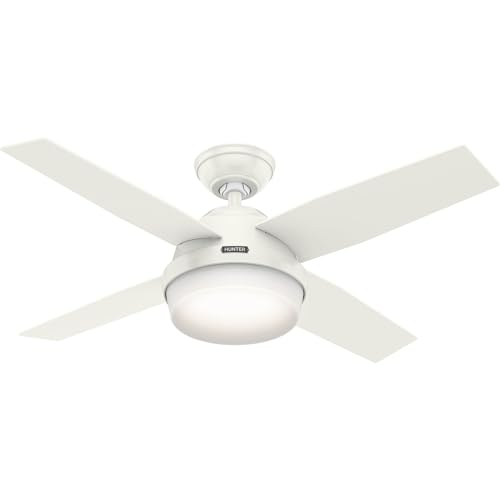


Check Lumens, Not Just Fixture Size
A ceiling fan's overall size tells you almost nothing about how bright its light kit is. Two fans with the same 52-inch blade span can carry very different light kits: one might use a small, decorative LED ring rated at a few hundred lumens, while another uses a larger integrated LED panel rated well over 1,500 lumens. The only reliable way to know is to check the lumen rating on the box, spec sheet, or listing before buying, the same way you would compare light bulbs.
What Counts as 'Enough' Light
General lighting guidance from the U.S. Department of Energy suggests roughly 1,500 to 3,000 lumens of ambient light for an average living room, with somewhat less needed for a bedroom used mainly for relaxing rather than close-up tasks. A ceiling fan light kit in that range, especially one with a warm 2700-3000K color temperature, can reasonably act as a room's main light source. A kit rated well under 1,000 lumens is better treated as supplemental or accent lighting, meant to pair with lamps or other fixtures rather than replace them.
Color Temperature Affects Perceived Brightness
Two fixtures with identical lumen output will not necessarily feel equally bright. A cooler color temperature (3500-4000K) tends to read as crisper and can feel brighter for tasks like reading, while a warmer temperature (2700-3000K) feels softer and more residential even at the same lumen count. If you are choosing between kits with similar lumens, consider color temperature alongside the raw number, especially in a room where you will also be doing close work.
Task Areas Still Need Their Own Light
Even a bright, well-specified ceiling fan light is a single, centrally located fixture. It generally will not eliminate shadows the way multiple light sources do, and it is not a substitute for dedicated task lighting over a desk, reading chair, or kitchen counter. If the room has a specific work area, plan on a lamp or under-cabinet light there regardless of how bright the fan's kit is.
Dimming Changes the Comparison
If the light kit is dimmable through the fan's remote or wall control, you get more flexibility to run it bright for cleaning or reading and low for evening ambiance, which can make a moderately bright kit feel more versatile than its peak lumen number suggests. Confirm the fan supports dimming (and how, since many integrated LED kits only dim through their own control, not a generic wall dimmer) if flexible brightness matters to you.
Bottom Line
Do not assume a ceiling fan's light kit will be bright enough for the room just because the fan itself is generously sized. Check the lumen rating against general lighting guidance for the room type, consider color temperature, and plan on supplemental task lighting for any area that needs focused light.