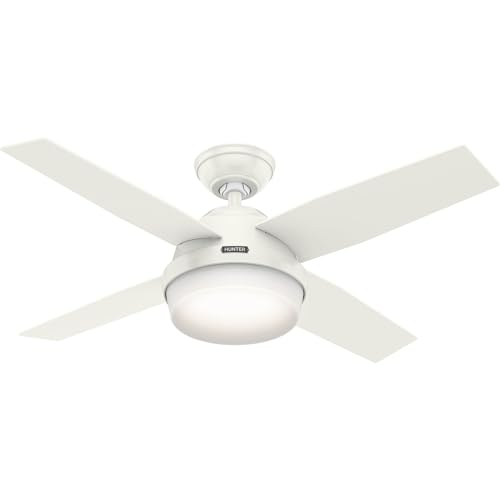


CFM Is the Real Measure of Airflow
Blade span and motor wattage get most of the attention on a spec sheet, but CFM (cubic feet per minute) is what actually tells you how much air a ceiling fan moves on its highest speed. Two fans with the same blade span can have noticeably different CFM ratings depending on blade pitch, motor torque, and overall design, so CFM, not size, is the number to compare when judging real-world performance.
General CFM Targets by Room Size
As a starting guideline for high-speed CFM output:
- Small rooms (bedrooms, home offices, under roughly 150 square feet): 1,000 to 3,000 CFM
- Medium rooms (living rooms, dens, 150 to 300 square feet): 3,000 to 5,000 CFM
- Large rooms (great rooms, primary bedrooms, 300 to 450 square feet): 5,000 to 6,000 CFM
- Extra-large or open-concept spaces (over 450 square feet): 6,000 to 9,000+ CFM, often from two fans rather than one
CFM per Watt: The Efficiency Number Worth Checking Too
Raw CFM tells you airflow, but CFM per watt tells you how efficiently the fan produces it. ENERGY STAR-certified ceiling fans are independently tested and required to meet minimum airflow-efficiency standards, and many manufacturers list this ratio directly. A DC-motor fan commonly delivers noticeably more CFM per watt than an equivalent AC-motor fan, which adds up over a fan that runs for hours at a time in summer. When comparing two fans with similar CFM ratings, the one with the higher CFM-per-watt figure will cost less to run.
Why "Good" CFM Depends on More Than the Number
A fan rated at 6,000 CFM won't deliver that performance if it's undersized for the room, mounted too close to the ceiling, or fighting a vaulted space where warm air pools overhead. CFM ratings are measured under standardized test conditions, so real-world airflow also depends on mounting height, downrod length, and how open or broken-up the floor plan is. In an open-concept space, two moderately rated fans spaced apart often move air more evenly through the whole room than a single fan chasing a very high CFM number.
Where to Find the CFM Rating
Reputable manufacturers publish CFM on the product spec sheet, the efficiency label, or the ENERGY STAR certification listing. If a product listing advertises only blade span, RPM, or wattage with no CFM figure at all, treat that as a sign the airflow performance either wasn't tested to a comparable standard or isn't strong enough to highlight, and look for a competing model that does publish it.
The Bottom Line
For most rooms, match CFM to square footage using the ranges above, favor a DC motor for better CFM-per-watt efficiency if the fan will run often, and confirm the mounting height and downrod length will actually put the fan in the airflow zone the rating assumes. For rooms over roughly 400 to 450 square feet, it's worth reviewing dedicated high-CFM, large-room fan options rather than sizing up a standard residential model.