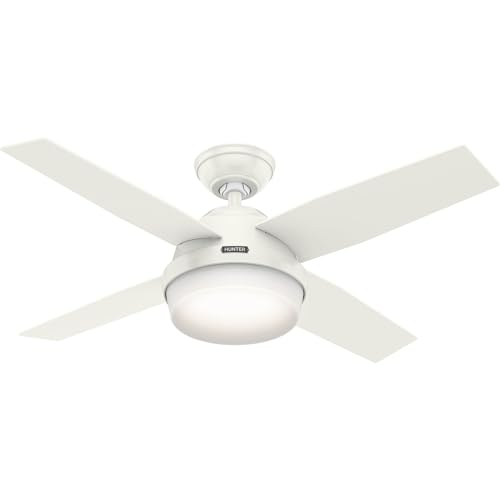


Sizing a Ceiling Fan for a Large Room
Blade span (the diameter the blades sweep) is the first spec most people check, and it's a reasonable starting point, but it needs to be paired with CFM, mounting height, and downrod length to actually deliver comfortable airflow in a large space.
Blade Span Guidelines by Room Size
- Rooms up to 175 square feet: 42 to 48 inches
- Rooms 175 to 350 square feet: 52 to 56 inches
- Large rooms, 350 to 450 square feet: 60 inches
- Great rooms and open-concept spaces over 450 square feet: 60 to 72+ inches, or two fans in the 52 to 60 inch range spaced across the room
Check CFM, Not Just the Blade Span Number
Blade span alone doesn't guarantee airflow. Look for a published high-speed CFM rating of at least 5,000 to 6,000 for a single large-room fan; if a listing skips this figure, that's worth treating as a caution flag rather than assuming size alone will perform.
Mounting Height and Downrod Length
For any fan to perform close to its rated CFM, it needs to hang in roughly the 8 to 9 foot zone above the floor, with a minimum 7-foot clearance required for safety in every case. Large rooms very often have 9, 10, or vaulted ceilings, and the downrod that ships standard with most fans, typically 3 to 6 inches, won't get the fan low enough into that zone. Most large-room fans offer optional longer downrods, commonly 12, 18, or 24 inches or more, and choosing the correct length matters more for felt airflow than upsizing the motor. For sloped or vaulted ceilings, confirm the fan's rated slope tolerance, commonly 30 to 45 degrees, and add a sloped-ceiling adapter kit if the pitch exceeds it.
Clearances to Furniture and Walls
Beyond floor clearance, leave at least 18 to 24 inches between the blade tips and any wall, and make sure tall furniture, bookshelves, or the airflow from fans in adjoining open spaces won't sit directly in a path that blocks circulation to the rest of the room.
A Safety Note Before Installing
Large fans are heavy, and in most homes they're hardwired rather than plugged in, often requiring a heavier-duty ceiling brace than a standard light fixture uses. Before any installation or downrod swap, turn off power at the breaker, confirm the ceiling box and brace are rated for the fan's weight and span, and bring in a licensed electrician for new wiring, box replacement, or any circuit work, or simply whenever you're not certain the existing setup is adequate. A permit and inspection are worth the effort for a fixture this size.
Quick Takeaway
For a large room, start with a 60-inch-or-larger fan (or two mid-size fans in an open floor plan), confirm it's rated for at least 5,000 to 6,000 CFM, and pair it with a downrod long enough to hang it in the 8 to 9 foot mounting zone rather than up near a high or vaulted ceiling.