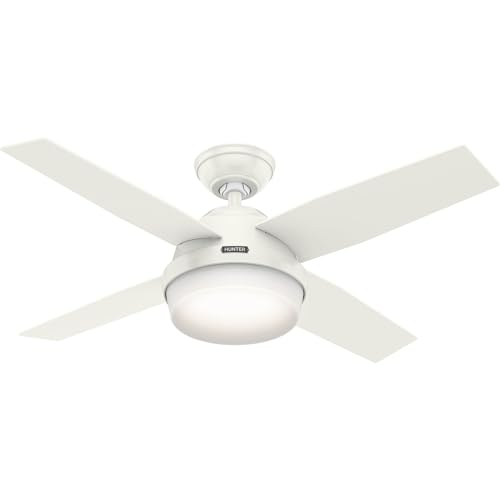


What Size Ceiling Fan Do I Need?
Ceiling fan size is based primarily on your room's square footage, then fine-tuned by ceiling height and how much airflow you actually want.
Start With Square Footage
Multiply the room's length and width in feet to get square footage, then match it to a blade span:
| Room Size | Blade Span |
|---|---|
| Up to 75 sq ft | 29-36 in |
| 75-144 sq ft | 36-42 in |
| 144-225 sq ft | 44-50 in |
| 225-400 sq ft | 50-54 in |
| 400+ sq ft | 56-72 in, or two fans |
A typical 10 x 12 ft bedroom (120 sq ft) calls for a 36-42 inch fan. A 20 x 20 ft great room (400 sq ft) is at the top of the single-fan range and may perform better with two fans instead of one very large one.
Then Check the CFM Rating
Blade span alone doesn't guarantee good airflow. Two fans of the same diameter can move very different amounts of air depending on motor strength and blade pitch. CFM, or cubic feet per minute, is the actual measure of airflow, and ENERGY STAR-certified fans list this figure so you can compare models directly instead of relying on size alone. For most bedrooms and living rooms, look for a combined CFM in the low thousands; large or open-plan rooms benefit from fans rated several thousand CFM or higher.
Adjust for Ceiling Height
A fan sized correctly for the floor area can still underperform if it's mounted too high or too low:
- On ceilings 8 feet or lower, use a flush-mount (hugger) fan so the blades don't hang too close to head height.
- On ceilings 9 feet and up, a downrod-mounted fan brings the blades down to the ideal 8-9 feet above the floor, where air circulation works best.
- On very tall or vaulted ceilings, a longer downrod is needed, roughly 1 inch of extra downrod per foot of ceiling height above 8 feet.
When in Doubt, Round Up Slightly
If your room falls right on the border between two sizes, or it gets a lot of direct sun, has high ceilings, or opens into another room, it's usually better to size up rather than down. An undersized fan that barely moves air is a common regret; a fan sized one notch larger, run on its lowest speed setting, is easy to dial back.
A Safety Reminder
If you're replacing a light fixture with a fan or moving a fan to a new location, remember that ceiling fans need a fan-rated electrical box and are heavier than most fixtures. Turn off power at the breaker before working on any wiring, and bring in a licensed electrician for new circuits or any wiring you're not fully confident handling yourself.