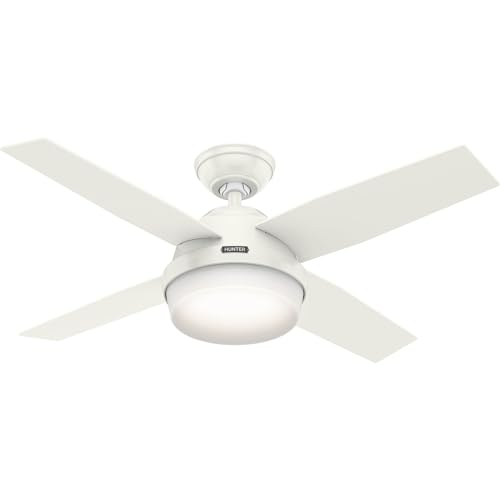


Sizing a Ceiling Fan Downrod
The downrod is the pipe between the fan motor and the ceiling mounting bracket, and getting its length right affects both airflow and safety clearance. Most fans ship with a short standard downrod (often around 3-6 inches) sized for a flat, 8-foot ceiling — anything taller usually needs a longer rod bought separately.
Step 1: Decide your target blade height
For best air movement, aim to have the blades sit 8 to 9 feet above the floor. This is the height range fan manufacturers generally recommend for effective airflow throughout a room. If your ceiling is very tall (vaulted, cathedral, or a converted loft), you can go lower than the ceiling itself as long as you respect minimum clearance.
Step 2: Respect minimum floor clearance
Keep at least 7 feet of clearance between the blades and the floor. This clearance guidance lines up with typical fan-mounting codes and manufacturer installation instructions, and it matters most in rooms with furniture like tall bookshelves or a loft bed where people's heads could otherwise come close to the blades.
Step 3: Measure and calculate
Step 4: Match diameter, not just length
Downrods aren't just sold by length — they also come in different rod diameters (commonly around 0.5 to 1 inch, depending on the fan's weight and brand). A downrod has to match your exact fan model's coupling; a rod from a different brand, even at the "right" length, often won't seat into the motor housing correctly. Check your owner's manual or the fan's model number before ordering, and buy from the same brand or a listing explicitly cross-referenced to your model.
Step 5: Match the finish if it will be visible
On a downrod-mounted fan, part of the rod is visible below the ceiling. Manufacturers typically offer several finish options (matte black, brushed nickel, aged brass, and so on) to match the fan's motor housing — worth checking so the extension doesn't look mismatched once installed.
Installation note
Swapping a downrod means briefly disconnecting the fan's wiring at the canopy to separate the motor from the mounting bracket. Turn off power at the breaker, not just the wall switch, before opening the canopy. The mechanical part of the swap (removing and reattaching the downrod pin) is usually straightforward, but if your ceiling box isn't already fan-rated, or you're not comfortable working inside the wiring compartment, bring in a licensed electrician rather than proceeding.