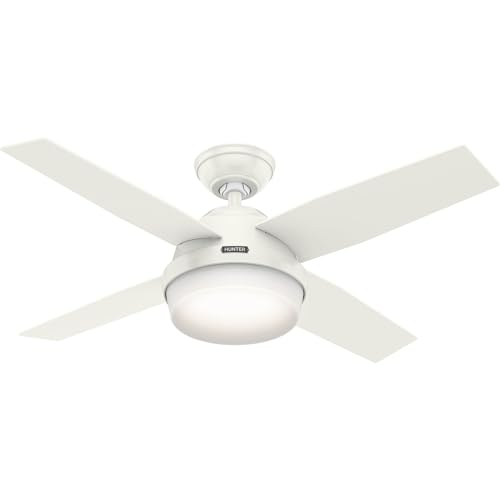


The Short Answer
For summer, a ceiling fan should spin counterclockwise when you look straight up at it from the floor. Run it on medium or high speed. This direction pushes air downward in a concentrated column that spreads out once it reaches you, creating a direct breeze.
Why Counterclockwise Works in Summer
The angled blades on a ceiling fan act like small airfoils. When they spin counterclockwise, they force air down and out rather than pulling it up. That downward airflow increases both evaporation and convective heat loss from your skin — the same wind-chill effect that makes a breezy day feel cooler than a still one at the same air temperature. ASHRAE's comfort research recognizes this elevated-air-speed effect as a real, measurable factor in how warm or cool a person feels, separate from the actual room temperature.
Because a stronger downdraft moves more air across your skin, summer mode is typically paired with a faster blade speed than winter mode uses. Most fans offer two or three speeds; for a warm room, high or medium-high is usually the better choice, dropping to a lower speed if the airflow starts to feel like it's scattering papers or blowing out candles.
Finding and Flipping the Switch
Standard fans have a small toggle switch on the side of the motor housing, near where the down rod or blades attach. It's usually easiest to reach with a step stool. Push it to the position that isn't currently selected, and you've reversed the direction.
Fans with a remote or wall control often skip the manual switch entirely and put the reverse function into the electronics, usually marked with a sun icon for summer and a snowflake or moon icon for winter. Smart, Wi-Fi or Bluetooth-connected fans handle the same function through an app.
Before you reverse a fan's direction by any method, turn it off and let the blades come to a complete stop first. Switching direction while blades are still spinning adds unnecessary strain to the motor and gearing over time.
Confirming It's Actually Set to Summer
If you're not sure which mode a fan is currently in, stand underneath it and watch a blade's leading edge as it moves. If the blades appear to sweep from your right to your left as they pass in front of you, the fan is in the counterclockwise, summer setting. You can also simply hold your hand up under the fan — a strong, direct downdraft confirms summer mode, while a gentler, indirect airflow means it's still set for winter.
A Reminder on What the Fan Is Doing
Running a fan in summer mode doesn't lower the temperature of the room — a thermometer left under a running fan reads the same as one under a stopped fan. What changes is how the air feels on your skin. Because of this, it only helps when someone is actually in the room, so turning the fan off when you leave saves electricity without giving up any comfort benefit. The U.S. Department of Energy notes that pairing a correctly-set fan with a thermostat set a few degrees higher than usual is one of the simplest ways to cut summer cooling costs.