

The short answer
Neither one actually lowers the room temperature. Both cool you by moving air across your skin so sweat evaporates faster. In practice, a pedestal fan usually pushes more air and cools a larger space quickly, while a tower fan is slimmer, quieter, and better suited to tight rooms and steady background airflow.
How each fan moves air
The two designs move air in fundamentally different ways.
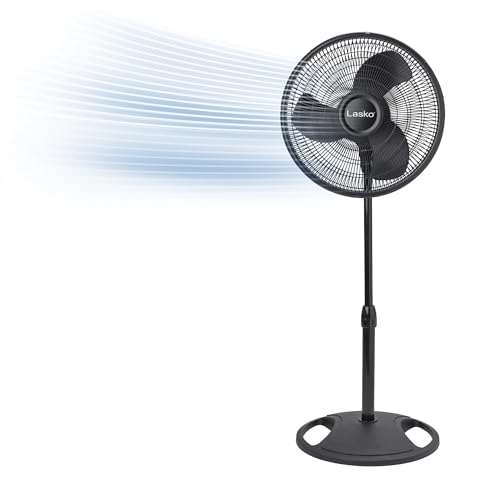
- Pedestal fans use a large spinning blade (often around 16 inches) on an adjustable-height stand. That big blade throws a strong, concentrated column of air a long distance, so you feel a distinct breeze even from across the room.
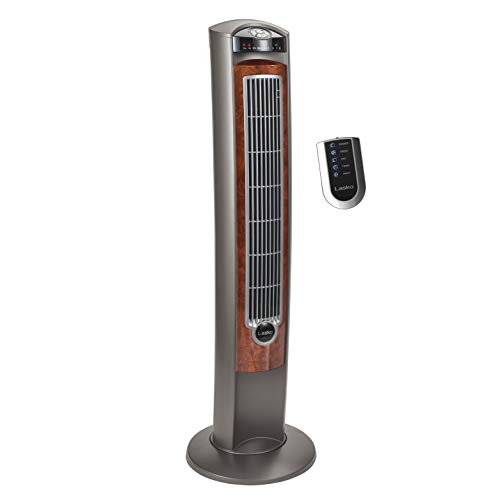
- Tower fans use a tall vertical cylinder with an impeller inside. They move air in a wide, softer sheet from floor level up to about waist or chest height. The breeze is gentler and spread over a taller vertical band.
Which one cools better
If raw cooling power and reach are what you want, the pedestal fan generally wins. Its larger blade and open design move more total air (higher CFM) and project it farther, so it cools a big or warm room faster and can reach a person sitting across the space.
The tower fan trades some of that reach for comfort and convenience. Its airflow is softer and more diffuse, which many people find more pleasant for long sessions, and its wide oscillation spreads a mild breeze across a room rather than blasting one spot.
So the honest answer to "which cools better" depends on what better means:
- Fastest, strongest cooling and longest reach: pedestal fan.
- Gentle, even, all-around airflow in a smaller space: tower fan.
Noise
Tower fans are usually quieter at comparable settings, and many run at a low hum that works well in a bedroom or office. Pedestal fans can be very quiet on low but tend to get louder at the high speeds where they shine. If near-silent operation matters more than maximum airflow, the tower fan has the edge.
Space, height, and placement
- Footprint: Tower fans have a small floor footprint and tuck neatly into a corner. Pedestal fans need more room and a stable base.
- Height: Pedestal fans adjust in height, so you can aim the breeze at a bed, a couch, or a standing person. Tower fans are a fixed height and blow from a lower band of the room.
- Reach: A pedestal fan raised to seat or bed height directs air more effectively across furniture, while a tower fan is better at ground-level circulation.
Oscillation and air distribution
Both oscillate, but differently. A pedestal fan sweeps a strong beam of air side to side, so any given spot gets pulses of strong breeze. A tower fan sweeps a wide, soft curtain, so the whole area gets steady light movement. For circulating stale air in a modest room, the tower's even sweep feels smoother; for cutting through heat in a large room, the pedestal's stronger sweep is more effective.
Cleaning and maintenance
This is a real practical difference. A pedestal fan's grille pops off, so you can wipe the blade and cage directly. A tower fan's internals are sealed behind a narrow housing that does not easily come apart, so dust builds up inside and is harder to remove, usually requiring compressed air through the vents. If easy deep-cleaning matters to you, the pedestal fan is simpler to maintain.
Energy use
Both are low-power appliances. A typical pedestal or tower fan draws somewhere from a few watts up to around 100 watts depending on size and speed, a small fraction of what an air conditioner uses. There is no meaningful cooling-cost advantage between the two categories, so choose based on airflow and comfort rather than electricity.
Safety and households with kids or pets
- Tower fans have no exposed blade and a stable, tip-resistant base, which many parents prefer around small children and pets.
- Pedestal fans have a guarded but more accessible blade and a taller center of gravity, so they can tip if bumped. A wide, weighted base helps.
Which should you choose
Pick a pedestal fan if you want to cool a large or hot room quickly, need to direct airflow at a specific height, and do not mind a larger footprint and a bit more noise at high speed.
Pick a tower fan if you want a slim, quiet unit for a bedroom, office, or small living space, prefer gentle even airflow, and value a small footprint with no exposed blade.
Bottom line
For maximum cooling and reach, the pedestal fan is the stronger performer. For quiet, space-saving, even airflow in smaller rooms, the tower fan is the better fit. Match the fan to the room and to how close you will sit to it, and either one will make a warm space feel noticeably more comfortable.