
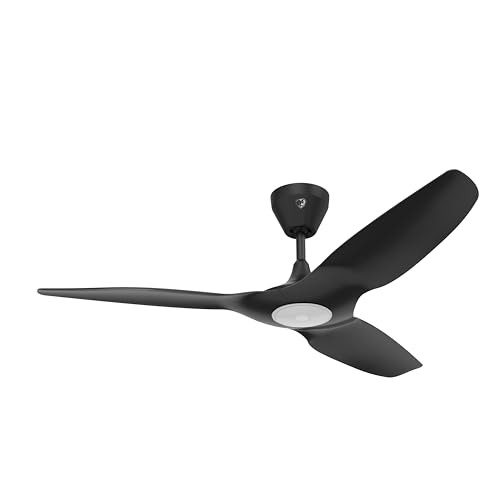


DC vs AC ceiling fan motors at a glance
DC-motor ceiling fans use roughly 30-70% less electricity than comparable AC fans, run quieter, start and stop faster, and usually offer more speed settings -- but they cost more upfront and rely on an electronic module. AC-motor fans are cheaper, proven, and simpler to service. For most homes that run a fan a lot, DC wins on efficiency and noise.
Both motor types spin the same kinds of blades; the difference is how they turn electricity into motion.
How the two motors differ
Household power is alternating current (AC). An AC fan feeds that current straight to the motor, and speed is changed by adjusting the voltage or using capacitors. A DC fan includes a small transformer and rectifier that convert AC wall power to direct current, then an electronic controller drives the motor. That controller is why DC fans get more speeds, smoother control, and features like precise reverse.
Energy efficiency
DC motors are the clear efficiency winner. They generate the same airflow (CFM) using significantly less power, often in the range of 30-70% less than an equivalent AC fan at comparable speeds. The gap is widest when a fan runs long hours, so bedrooms and living rooms used all day or night benefit most.
If you want a simple proxy, compare CFM per watt on the spec sheet: DC fans usually post far more airflow per watt than AC fans of the same size.
Noise
DC fans tend to run quieter. The electronic controller allows lower, steadier low speeds, and the motors typically produce less hum. For a bedroom or nursery where you want gentle air movement without a drone, that low-end quiet is a real advantage. AC fans are not necessarily loud, but their lowest usable speed is often higher, and cheaper AC units can hum on certain speeds.
Speeds and control
- AC fans: commonly 3 speeds, controlled by a pull chain or a basic wall control.
- DC fans: commonly 6 speeds, almost always with a remote, and often app or smart-home control, plus quicker start, stop, and reverse.
Weight, size, and design
DC motors are generally more compact and lighter for the same output, which lets manufacturers build slimmer, lower-profile housings. That is partly why many modern, minimalist fans use DC motors.
Upfront cost and value
AC fans are cheaper to buy. DC fans carry a price premium for the motor and electronics. Whether the energy savings repay that premium depends on how many hours the fan runs and local electricity rates -- a fan running many hours a day recovers the difference faster than one used occasionally. If a fan runs only briefly on mild days, the payback is slower and an AC fan may be the sensible pick.
Repairability and longevity
This is where AC has an edge. AC fans are simple, and their parts (capacitors, pull-chain switches) are widely available and cheap. A DC fan's efficiency comes from an electronic control module, and if that module fails outside warranty, it can be harder or costlier to source than a capacitor. Buying from an established maker with good parts support reduces that risk.
Remote dependence
Most DC fans are controlled electronically and ship with a remote; some have no pull chains at all. If the remote is lost, you need a replacement or the matching wall control. AC fans more often keep a manual pull chain as a fallback.
Which should you choose?
- Choose DC if you run the fan many hours a day, want the quietest low speeds, value more speed settings and smart control, or want a slim modern look. The efficiency and quiet are worth it for primary bedrooms and living rooms.
- Choose AC if upfront price is the priority, the fan will see light use, you want the simplest possible repair path, or you prefer a manual pull chain.
Installation and safety
DC and AC fans wire into the ceiling the same way, and both need a fan-rated electrical box that can support the weight and motion. Turn off power at the breaker before wiring, confirm the box is rated for a fan, and hire a licensed electrician for hardwiring, a new circuit, or anything you are unsure about. DC fans add a receiver module in the canopy, so leave room for it. This is general information, not a substitute for a licensed electrician.
Bottom line: DC motors win on efficiency, quiet, and control; AC motors win on price and simple repairs. For a fan that runs a lot, DC usually pays off in comfort and lower running cost.


