


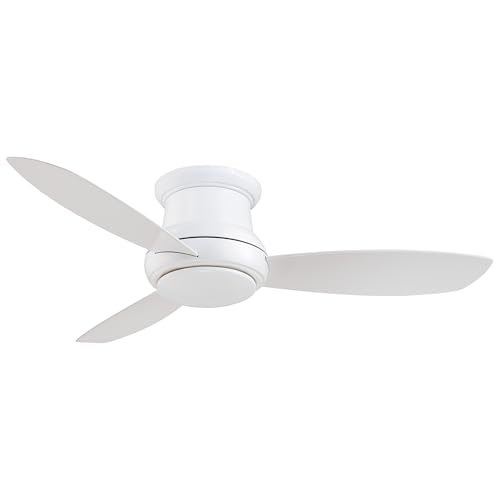


42-inch vs 52-inch: the short answer
Choose a 42-inch ceiling fan for rooms up to about 144 square feet (bedrooms, kitchens, offices) and a 52-inch fan for rooms from roughly 145 to 300 square feet (living rooms, large bedrooms, dens). The 52-inch moves more air over a wider area; the 42-inch fits tighter spaces without feeling overpowering.
Both are among the most common sizes sold, which is exactly why people end up choosing between them. Here is how they compare on the things that matter.
Room size and coverage
Blade span is the diameter of the circle the blades sweep, and it decides how far the airflow reaches.
- 42-inch: best for 100-144 sq ft. Think a 10x12 bedroom, a kitchen, a home office, or a small dining room.
- 52-inch: best for 145-300 sq ft. Think a 15x15 living room, a primary bedroom, or an open den.
Airflow (CFM)
CFM (cubic feet per minute) measures how much air a fan moves on high. Larger blades generally move more air at the same motor effort, so a 52-inch fan typically posts higher CFM than a comparable 42-inch model. That is an advantage in a big or warm room, and a drawback in a small one where the extra airflow just feels like wind.
What matters is matching CFM to the space: a smaller room needs less air movement to feel comfortable, so the 42-inch fan's lower output is a feature, not a weakness.
Clearance and fit
The physical space caps your choice:
- Keep blade tips 18-24 inches from any wall. A 52-inch fan needs a center point at least about 44-50 inches from each wall to clear comfortably; a 42-inch fan needs less.
- Keep blades 7-9 feet off the floor and 8-10 inches below the ceiling.
Look and proportion
Size is visual as well as functional. A 52-inch fan anchors a large room and can look undersized only in a great room. A 42-inch fan suits a modest room where a 52-inch would visually press down on the space. As a rule, the fan should feel proportional to the room and to the furniture below it.
Efficiency and noise
Neither size is automatically more efficient -- motor type (AC vs DC) and blade design matter more. That said, a right-sized fan runs at a lower speed to reach the same comfort, and lower speed means less noise and less energy use. An undersized 42-inch fan forced to run on high in a big room can be louder than a 52-inch fan loafing on medium. Sizing correctly is the quieter, more efficient choice either way.
When the room is between sizes
If your room lands near 144 sq ft (roughly a 12x12), either size can work:
- Choose 52-inch if the ceiling is 9 feet or higher, the walls are far enough for clearance, and you want stronger airflow.
- Choose 42-inch if the ceiling is 8 feet, a wall is close, or you dislike a strong breeze.
Quick comparison
- Small to medium rooms, tight clearances, gentle breeze: 42-inch.
- Medium to large rooms, higher ceilings, stronger airflow: 52-inch.
- Proportion: 42-inch for modest rooms, 52-inch to anchor larger ones.
- Comfort: match CFM to room size rather than chasing the biggest number.
Installation safety
Whichever size you pick, installation involves the ceiling box and wiring. Turn off power at the breaker first, verify the electrical box is fan-rated (a standard lighting box is not), and hire a licensed electrician for hardwiring, a new circuit, or anything you are unsure about. This is general guidance, not a replacement for a licensed electrician.
Bottom line: pick by room size and clearance first. A 42-inch fan is the safe default for bedrooms and small rooms; a 52-inch fan is the default for living rooms and larger spaces. Confirm wall clearance before you buy, and let the room -- not the price tag -- decide.


