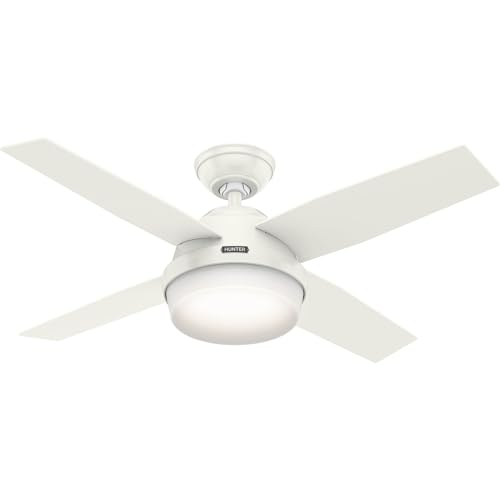
You can make a regular ceiling fan smart without rewiring by adding a device that intercepts its existing controls: an in-canopy smart module, a smart fan wall control that reuses the current wires, or a smart-compatible remote or hub for a pull-chain fan. Each adds app and voice control while keeping your existing wiring in place.
Start by identifying how your fan is controlled now
The right no-rewire method depends on how your fan currently receives power and commands. Three common setups cover most homes:
- Wall switch only - one or two switches on the wall run the fan and, sometimes, a light kit.
- Pull chains - you change speed and light with chains hanging from the fan, and a wall switch just cuts power.
- Existing handheld remote - the fan already has a receiver in the canopy and a battery remote.
Option 1: In-canopy smart controller module
A smart controller (sometimes called a fan control module or receiver) is a small device that tucks into the fan's canopy - the dome that covers the mounting bracket - and sits between the incoming wires and the fan motor and light. It reuses the conductors that are already there; you are connecting to existing wires, not running new ones.
Once installed, it pairs with an app over Wi-Fi or a hub, giving you speed control, light dimming, scheduling, and voice control through common assistants. It is the most built-in feeling upgrade, because the fan keeps working normally from the wall while gaining app control.
Best for: fans with a switched wall feed and enough room in the canopy for the module. Because it involves disconnecting and reconnecting fan wiring, treat it as electrical work.
Option 2: Smart fan wall control
If your fan runs off a wall switch, you can swap that switch for a smart fan control designed to handle a fan motor. This is often the cleanest route: the control lives in the wall box, reuses the existing wiring, and adds app scheduling, speed steps, and voice commands.
A few cautions matter here:
- Use a control rated for ceiling fan motors, not a plain smart lamp dimmer. A dimmer on a fan motor can cause humming, overheating, or damage.
- Many smart switches need a neutral wire in the box. Older homes may not have one, so check before buying.
- If one switch currently runs both the fan and its light on the same wire, you may only get combined control unless the fan itself separates the two.
Option 3: Smart remote or hub for the existing receiver
Some fans already have a radio receiver in the canopy paired to a handheld remote. In that case you may be able to add a bridge or smart remote system that talks to that receiver, or replace the receiver with a smart version. This can deliver app and voice control with minimal fuss when the parts are compatible.
The catch is compatibility: frequencies and protocols vary, so a smart remote solution has to match your fan's receiver. When it works, it is one of the least invasive upgrades, because the fan's internal wiring stays untouched.
Option 4: Smart plug (rarely the right fit)
A smart plug only helps if the fan plugs into an outlet, which is unusual for a hardwired ceiling fan. Even where it applies, it only turns the whole fan on or off - it cannot change speed or dim the light, and cutting power mid-run is hard on the motor and resets pull-chain settings. Treat this as a last resort, not a real smart-fan solution.
Matching the method to your goal
- Want the most features (speed, dimming, schedules)? An in-canopy module or a proper smart fan wall control.
- Want the simplest swap? A smart fan wall control, if you have a neutral wire.
- Fan already has a remote receiver? Look at a compatible smart remote or receiver upgrade first.
- Renting or avoiding any wiring? A compatible smart remote system is often the least invasive.
What "no rewiring" really means
"No rewiring" means you are not running new cable through walls or ceilings or adding new circuits - you reuse the conductors already feeding the fan. It does not mean no electrical work at all. In-canopy modules and wall-control swaps still require connecting to live household wiring.
Electrical safety note
Before any canopy or wall-box work, turn off power at the breaker - not just the wall switch - and confirm the wires are dead with a tester. If you are adding a smart module, replacing a fan wall control, or you are unsure about neutral wires, box fill, or fan ratings, hire a licensed electrician. This article is general information, not a substitute for a licensed electrician.
Setting realistic expectations
A retrofit smart fan will not always match a purpose-built smart fan feature for feature. Speed steps may be limited, light dimming depends on the bulbs and control, and voice or app response can vary with your network and hub. Still, for most homes, one of these no-rewire methods delivers the wins people actually want: schedules, voice commands, and phone control - without opening the walls.