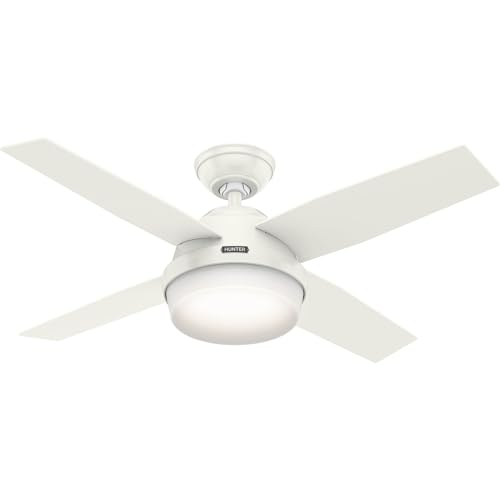
The main difference is range and access. Wi-Fi ceiling fan control connects through your home network, so you can operate the fan from anywhere and use scheduling and voice assistants. Bluetooth control works only within roughly 30 feet, phone to fan, with no remote access - but it is simpler and does not depend on your router.
How each connection actually works
Wi-Fi control links the fan (or its smart module or wall control) to your home router. Because the router is connected to the internet, the fan effectively joins your smart-home ecosystem. Commands can come from a phone app, a schedule running in the cloud, or a voice assistant - whether you are in the next room or on the other side of the country.
Bluetooth control is a direct, short-range radio link between your phone and the fan. There is no router in the middle and no internet involved. Your phone talks straight to the fan, which keeps the setup simple but limits everything to the range of that direct signal.
Range and remote access
This is the difference most people feel day to day.
- Wi-Fi: works anywhere you have internet. Turn the fan on before you get home, or shut it off after you have left. It also lets multiple household members control the fan from their own phones without pairing each time.
- Bluetooth: works only when your phone is within about 30 feet and roughly in line of sight. Walk to another floor and the connection usually drops. There is no way to control the fan when you are away.
Voice assistants and automations
Wi-Fi fans generally integrate with common voice assistants and smart-home platforms, so you can say a command, add the fan to a routine, or trigger it from a temperature sensor. Schedules ("off at midnight," "on at 6 p.m.") run reliably because they live on the network or in the cloud.
Bluetooth fans can sometimes respond to voice or schedules, but only while your phone is present and the app is active, which makes true hands-off automation unreliable. For a fan you want folded into a broader smart home, Wi-Fi is far more capable.
Setup and reliability
Bluetooth wins on simplicity. Pairing is quick, there is no network password to enter, and there is nothing to reconfigure if you change internet providers. If your Wi-Fi goes down, a Bluetooth fan still responds to your phone.
Wi-Fi setup takes a few more steps - joining the fan to your network and, often, an account - and the fan depends on your router staying up. On a weak or congested network, response can lag. A strong, well-placed router usually makes this a non-issue, but it is a real dependency that Bluetooth avoids.
Network load and privacy
Every Wi-Fi device adds one more connection to your network and, typically, one more cloud account holding some usage data. That is worth considering if you are privacy-minded or already have a crowded network.
Bluetooth keeps everything local: no cloud account, no network entry, and no remote exposure. For anyone who prefers to keep devices off the internet, that local-only nature is a genuine advantage.
Battery and power notes
Neither method changes how the fan itself is powered - both control a fan wired into your home. The difference is in the control device's radio. Bluetooth's short-range radio is simple and low-drain on the paired phone, while Wi-Fi control keeps the fan's module in steady contact with the router. In practice, the energy difference is negligible; choose based on features, not power draw.
Which one should you choose?
Pick Wi-Fi if you want to:
- Control the fan while away from home
- Use voice assistants and smart-home routines
- Run reliable schedules
- Let several people control it from their own phones
- Keep setup dead simple
- Avoid adding a device to your network or a cloud account
- Keep control fully local and private
- Have control that still works if the internet is down
Can a fan have both?
Some smart fans and modules support both, using Bluetooth for quick local setup and pairing, then Wi-Fi for full remote and voice features. If you find one that offers both, you get the easy pairing of Bluetooth with the reach of Wi-Fi - the best of both worlds for most households.
A quick safety note
Whether the control is Wi-Fi or Bluetooth, installing a smart fan module or replacing a fan wall control means working with live household wiring. Turn off power at the breaker - not just the wall switch - and confirm the wires are dead before you touch them. For hardwiring, new circuits, or anything you are unsure about, hire a licensed electrician. This article is general information, not a substitute for a licensed electrician.
The bottom line
Wi-Fi buys you reach: remote access, voice control, and dependable automation, at the cost of a slightly more involved setup and a reliance on your router. Bluetooth buys you simplicity and privacy, at the cost of range and away-from-home control. Match the trade-off to how you actually plan to use the fan, and either can serve a home well.